Showing posts with label Logic/Reason. Show all posts

Thursday, May 20, 2010

.

Faulty logic: Post hoc, ergo propter hoc

For the next in the series on faulty logic, we have:

Post hoc, ergo propter hoc

It’s a natural tendency for people to make connections between events. “When I do this, that happens.”

When I touch something hot, I get burned.
When I don’t water my house plants, they die.
When I eat that kind of mushroom, I get sick.

As we see these connections, we often make an assumption that the prior (or coincident) event caused the other. Touching my hand to a hot stove causes my hand to be burned. Failing to water my plants kills them. Eating the wrong mushrooms makes me sick. And inferring causation is a good defense: it makes me avoid touching hot things or eating bad mushrooms. Of course, it might make me avoid eating all mushrooms, depending upon my lack of exposure to other kinds, but, you know, that’s OK: overreacting, making a rash inference can sometimes be better than the alternative.

Of course, some connections turn out to be faulty. When I go to New Jersey, it rains. We certainly know that my going to New Jersey doesn’t cause the rain. Perhaps we have a case of confirmation bias, where I’m forgetting the visits to the Garden State when it’s been sunny. Or maybe I’ve been there so few times that my sample size isn’t large enough to make any inference. I know someone who won’t eat Thai food, because “Thai food makes me sick.” How many times has that person eaten Thai food? Once.

Primitive people developed superstitions in similar ways. One year, the crops were bad. The next year, they put a basket of dead birds in the middle of the field, and the everything turned out great. Therefore, placing a basket of dead birds in the field ensures a good crop.

Coincidence (or correlation) does not imply causation.

The logical fallacy of assuming that it does is called “post hoc, ergo propter hoc”, a Latin phrase meaning “after this, therefore because of this” (or the similar “cum hoc, ergo propter hoc”, “with this, therefore because of this”).

Like the primitive farmers, we continue to make assumptions of causation, sometimes casually, sometimes to support what we already believe, sometimes to grasp at an explanation for something we desperately want explained. Post hoc, ergo propter hoc (often coupled with confirmation bias) leads us to think that vaccines are harming children, that prayer works (you pray for your sports team to win, and they win; you pray for good weather, and it's a nice day), or that taking off our shoes at the airport keeps terrorists away.

Instead, it’s important that we not jump to conclusions. We should make multiple observations. We should try different sequences in various combinations. We should design studies that test our hypotheses against alternatives, and we should consider alternative explanations.

Even with all that, we might never be sure about the real causes. But we can rule some out, and we can increase our confidence in others.

Correlation
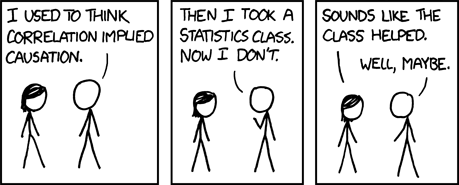
Correlation
(Click to see the cartoon on the xkcd site.)

Friday, January 08, 2010

.

Faulty logic: Appeal to Popularity

It’s been too long since I’ve written an installment of the series on faulty logic. It’s time to continue it, with...

Appeal to Popularity

There was a time when pretty much everyone thought that the Earth was flat. There was a time when anyone who thought about it was sure the sun went around the Earth. Come to mention it, there was a time when that was widely attributed to its having a ride on Apollo’s chariot. These were popular ideas.

But an idea’s popularity doesn’t make it right; it only makes it popular.

Of course, we use popularity to sell products all the time. “Mr Coffee is the best-selling drip coffee maker,” was presented to us as a reason to buy Mr Coffee. We’re urged to buy the best-selling aspirin and the most popular car, and to shop “Where America Shops.”

And an argument we often hear for the existence of God is that most people believe it. “Billions of people can’t be wrong.”

Well, yes, they can. Popularity doesn’t imply truth. We’ve spent a lot if time believing popular things, favouring popular things, supporting popular things... until they were no longer popular.

Now, we may, indeed, infer something useful from popularity when it comes to buying products. A brand might be the most popular because it really is the best. Then, again, the popularity could be due to good marketing and wide distribution and availability. It’s most useful to look at why it’s the best-selling pasta sauce or the most popular brand of cat food.

With scientific issues and the like, there’s also some value in considering “popularity”, but, here, in a different sense: where do the experts stand, who have studied the subject and know it intimately? In this case we’re not applying faulty logic, through appeal to popularity, but, as in the appeal to authority discussion, we’re looking to appropriate experts for their expert opinions.

Likewise, we could get the opinions of trained, expert food tasters for opinions on the best brands of food. We might poll those who prepare coffee professionally for their thoughts on the best coffee makers.

But our experts still need to have some sort of data behind their opinions, and we have to be careful in how we choose. Who, for instance, might we go to for expert opinions on God? One’s very assertion of oneself as an expert presupposes God’s existence.[1] Experts in astrology, homeopathy, and feng shui are fine if you think these things are real and are looking for advice on that basis. But they won’t do us any good for studying the validity of the basic assumptions, and then we go back to the fallacy that popularity implies truth.

Appeal to Popularity: Just because a lot of people think something’s true, doesn’t make it so.


[1] Contrast this with study of religion itself, where one certainly can be a scholar on religious beliefs, cultural aspects of religion, and so on, independent of any such presupposition.

Tuesday, November 24, 2009

.

Faulty logic: Argument ad hominem

We’ll resume normal blogging after the Japanese break with the next in the series on logical fallacies. It’s time for...

Arguing ad hominem

From Latin for “to the man”, an ad hominem argument is one that attacks the speaker, rather than the issues. We all know this one; we see it all the time. We likely use it all the time ourselves, even though we try not to. “Oh, don’t listen to him; he’s a {kook | liberal | wing-nut | Nazi | moron | ...}.” C’mon: tell you’ve never said anything like that.

In a way, arguing ad hominem is the opposite of appeal to authority. In that, we’re asking the listener to accept someone’s argument because she’s especially deserving of attention. In this, we’re asking the listener to reject someone’s argument because she’s not worth our attention — but in both cases, we’re not addressing the content of the argument.

Colloquially, we’ve taken to generalizing the sense of ad hominem, pulling it out any time someone says something bad about her opponent. From the point of view of reasoned argument, though, we only hit the faulty logic when we use a personal aspect instead of addressing the substance of the arguments being made. I might or might not be bothered to have my interlocutor call me a crazy bastard, but questions about my sanity or parentage are irrelevant to whether or not I’m right.

Impolite, but logically sound: “He’s a crazy bastard! He’s wrong for the following reasons: (1) [...etc...]”

Impolite, and unsound, employing argument ad hominem: “He’s a crazy bastard! I don’t know why anyone bothers listening to him.”

Now, this fallacy brings us to a sticky point: if we say that ad hominem arguments are never valid, we’re pretty much saying that everyone is worth listening to and arguing with. If we can’t dismiss some people as “crazy bastards”, we leave ourselves open to denial-of-service attacks, having to fend off one opponent after another, each of whom should have been dismissed summarily, as Barney Frank did in August:

On what planet do you spend most of your time?

[...]

Ma’am, trying to have a conversation with you would be like trying to argue with a dining room table. I have no interest in doing it.

Ad hominem for sure, but... I agree with him, and I love the way he did that. What to do?

Sticking to the argument helps. It might seem that there’s little difference between “You’re an idiot, and you’re not worth responding to,” and “Your argument is so idiotic that it isn’t worth responding to,” but there really is quite a significant difference between them. But it’s still best to refute the arguments when you can.

Friday, November 06, 2009

.

Faulty logic: Appeal to Authority

Continuing the series on faulty logic, today we’ll look at:

Appeal to Authority

In our society, we hold various people up as authority figures, those we’re inclined to pay attention to. It’s not always clear why we have some folks on that list, really. Political leaders, such as presidents, prime ministers, kings, queens, senators, and governors are obvious. Educators and other academics — professors, scientists, and the like — also make sense. I’m never sure why actors and sports figures are there, but they do seem to be.

And so we have things like the 1970s advertisements for Mr Coffee, where former baseball player Joe DiMaggio told us what a great cup of coffee it made. Or more recently, when former Senator Bob Dole hawked Viagra.

Ads such as those are quintessential examples of appeal to authority: basing an argument on the support of an authority figure, without regard to the actual issue at hand.

  • Joe DiMaggio likes Mr Coffee, so it must be good.
  • The president said it; it must be true.
  • That guy has a PhD; he must be right.

A key point, though, is that the speakers credentials are often not irrelevant, and it’s often proper to cite them. When a doctor tells you about a medical issue that falls within her specialty, you should consider that along with other data. The appeal to authority hits us as a fallacy when the credentials aren’t relevant to the issue at hand (if DiMaggio had told us which baseball mitt to buy, that would have been great, but he wasn’t authoritative about coffee), or when they’re used to claim that other evidence is unnecessary (even a cancer specialist will support her statements about cancer treatment with real data).

Arguments that something is so because it’s in the Bible (or the Koran, or the Talmud, or other religious writings) are also faulty appeals to authority — mixed with other errors that we’ll get to later in the series.

We’re seeing the effects of appeal-to-authority arguments with the many “celebrity spokesmen” who stand behind pseudoscience and pseudomedicine. Oprah Winfrey, Jim Carrey, Robert Kennedy, and others contribute to a false fear of vaccination. Deepak Chopra and Andrew Weil are among those who use their real credentials as medical doctors to promote bogus “medicine”, talking about “removing toxins” and “boosting the immune system”, with no clinical data to back it up.

Of course, the “good guys” trot out authority figures as well. Musician Bono toured Africa in support of AIDS prevention and treatment. Former Senator and former Vice President Al Gore made a movie about global climate change. The difference is that these guys showed the data to back up what they were saying. An Inconvenient Truth is full of charts and figures and photographs that make the arguments clear. There’s no false appeal to authority there.

Friday, October 23, 2009

.

Faulty logic: False Dichotomy

It’s time for number two in a series of posts on faulty logic. Today’s fallacy:

False Dichotomy

We like things to be black or white, tall or short, here or there. We like to consider two sides to every story.

Unfortunately, there aren’t always two sides. Sometimes there’s only one; more often, there are multitudes. Many facets on the stone. Nooks and crannies in abundance. Things are usually not either black or white, but multicoloured. As it’s hard to argue a case with so many variations, we narrow the scope, and argue one side against another.

The trouble comes because we tend to define the two sides in a lopsided manner, revealing our biases and mischaracterizing one side or the other. If you’re not “pro-life”, what are you? Anti-life? Of course not: it’s a false dichotomy.

Either you supported the invasion of Iraq, or you’re on the side of the terrorists.
Either you want to stop hurting our children with vaccines, or you don’t care about the children.
Either you believe in God, or you’re an amoral robot.

False dichotomies, all. (And, of course, the examples I chose themselves form a kind of false dichotomy, by implying that only certain people — characterized here as “people who disagree with me” — argue from false dichotomies. But it’s not true: we all fall into this trap from time to time. More significantly, we all go this way purposefully sometimes, as a rhetorical technique.)

It’s important to learn to recognize the false dichotomies when we see them — they’re not usually laid out as clearly as above, but are imbedded within the argument. To tease it out, look for any too-succinct characterization of your interlocutor’s opponent. When she removed the complexity, she likely removed a lot of the reality, as well.

In the current health-insurance debate[1] we’re seeing a lot of false dichotomies that are manifested as flat characterizations of “the alternative”, as though that were the only possible alternative. I’m inclined to say that if we don’t go to a single-payer system, what we’ll have will still be broken. That’s my stand, so it’s right, of course... but it’s a false dichotomy. There certainly are alternatives that can be set up to work. Others say that a “public option” will give us socialized medicine (whatever that really means). Another false dichotomy.

Here’s a good set, through a chain of faulty reasoning: a public option for insurance becomes “government-run health care”, leading to “health-care rationing” for the elderly and disabled. When I see a chain of reasoning like that, my Skeptic Sense tingles, and I start breaking it down. In this case, we have the claim that either the government stays entirely out of health insurance or we end up with government-run care. There’s the first false dichotomy. The next step is that if the government runs health care, it will have to focus on saving money, not on giving care. There’s the second problem: does anyone really think that private health insurance isn’t trying to save money as well? Now, with the government needing to save money, they will withhold care from “hopeless cases”. Those are all presented as black-and-white choices, when, of course, they’re not.

If we can pull apart the fallacies, we can get to the things we really do have to solve. How do we make sure people who need care get it? How do we pay for it? How do we manage it? There aren’t simple answers to these, and false dichotomies only get in the way of working through them.

The same is true in other domains. Breaking things down into alternatives makes them easier to argue. But if we’re not careful in how we break them down, we actually block reasoned, productive arguments.


[1] We’re not really arguing about health care; we’re arguing about what to do about health insurance. Discussions of the quality of care certainly enter into it, but the real point of the issue is how to pay for the care we need.

Monday, October 12, 2009

.

Faulty logic: Confirmation Bias

In “On being a skeptic”, I said that skeptics look at evidence and make rational judgments based on the evidence:

We don’t say, “Bullshit!”, and we don’t say, “It’s a scientist saying it, so it must be true.” We look at the evidence.

I note that non-skeptics — or those who style themselves as a different kind of skeptic — also put forth “evidence” and claim support from it. But their evidence turns out to be faulty, and, often, the fault is in their reliance on one of more logical fallacies. They’re using faulty logic, which is generating faulty evidence, which is supporting... not any judgment they might make from what they see, but what they’ve already determined they want to believe.

I thought I’d have a look, in a series of posts, at some of the common logical fallacies. I’ll start with the one that’s perhaps the hardest for us to avoid, one that most of us have to work hard not to fall into ourselves:

Confirmation Bias

Simply put, confirmation bias is seeing what you want or expect to see, and ignoring what contradicts it. When you get stopped at a traffic light, and you say, “This light is always red when I come to it,” that’s probably confirmation bias. When I blogged, a couple of years ago, about how I seem to see 11:11 or 1:11 on my clock more often than I statistically should, that was confirmation bias. I know about confirmation bias, and it’s still hard for me to see 11:11 on the clock and not think, beneath my smile, “See: there’s something to this.”

But to those who aren’t aware, or who deny it, confirmation bias is a huge trap. It’s what makes us remember all the stories about bogus remedies that “worked”, because we forget the times when they didn’t. It’s what makes us certain that prayer works, because we ignore all the cases when it doesn’t. When we expect to see God everywhere, confirmation bias has us see Jesus and Mary in cheese sandwiches, wall plaster, and cow patties. When we think a psychic can really see things, or that astrology is predictive, we find sense and truth in their vague, equivocal statements through confirmation bias.

That’s where the scientific method comes in. Science has us control a study, record all observations, and then see if there’s really support for our thesis. Record the state of the traffic light every time, and see if it’s really red more often than not. Record the time whenever you look at the clock, and see how much 11:11 really does come up. Show people a bunch of random images, and measure their inclination to find Jesus in them... then see what else that correlates to.

It’s also important to remember that confirmation bias fools even the wary, sometimes in subtle ways. Its biggest danger is that it leads us to confirm our hypotheses, rather than to truly test them with counterexamples. When we design studies, we must make sure we take that into account, putting in sufficient challenges, as well as supporting cases. For example, if our hypothesis is that plant X is only found near water, we can’t test that hypothesis by only looking near water; we also must look where we don’t expect to find it, to make sure that we don’t find it there.

Want some real examples of confirmation bias? Here’s an item from the NY Times a year and a half ago, about the taste of wine:

But assuming for the moment that it’s true that most drinkers prefer the cheap stuff, why does anyone bother buying $55 cabernet? One answer is provided by a second experiment, in which presumably sober researchers at the California Institute of Technology and the Stanford Business School demonstrated that the more expensive consumers think a wine is, the more pleasure they are apt to take in it.

The researchers scanned the brains of 21 volunteer wine novices as they administered tiny tastes of wine, measuring sensations in the medial orbitofrontal cortex, the part of the brain where flavor responses apparently register. The subjects were told only the price of the wines. Without their knowledge, they tasted one wine twice, and were given two different prices for that wine. Invariably they preferred the one they thought was more expensive.

Note that the study isn’t working on subjective reporting: their brains are actually responding differently, depending upon how much they think the wine costs. This is really wired into us.

And this item just appeared in New Scientist the other day. This one is subjective, but still interesting.

Sixty people in turn were shown the same video clip on the same television. Half were told to expect clearer, sharper pictures thanks to HD technology: an impression backed up by posters, flyers and the presence of an extra-thick cable connected to the screen. The other half were told to expect a normal DVD image.

Questionnaires revealed that the people who had been led to expect HD reported seeing higher-quality images. “Participants were unable to discriminate properly between digital and high-definition signals,” says Lidwien van de Wijngaert at the University of Twente in Enschede, the Netherlands, who carried out the study with colleagues from Utrecht University.

In fighting confirmation bias, double-blind tests, randomized data, and peer review are your friends.