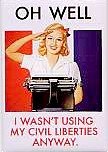
Some friends and I were talking, the other day, about being stuck behind school buses in the mornings, about how the buses stop at each street or at each house, about how parents wait with the children. And about how that’s different from “before”, and whether the change makes sense.
When I was in grade school, I walked or took the public bus(!) through third grade (I was riding the public bus by myself from the age of six, paying the fare and knowing which stop was mine), and rode a school bus from fourth grade on. I walked half a mile to the grounds of another school, where some twenty kids met, hung around, engaged in horseplay, and waited for the bus to our school. There were never adults around, and we never thought there should be.
More importantly, our parents never thought there should be.
Today, we worry. We don’t want the kids walking to a bus stop in the mornings, lest they be hit by cars. We don’t want them left alone, lest they be snatched. We worry about attacks, kidnappings, sexual assaults, murders, and we lock things down to protect ourselves, our children, our families.
Does it really make sense? These things do happen, to be sure, but they happen so infrequently that the chance of something happening to you is vanishingly small. Yet you want to be sure, and, indeed, my quoting statistics that show how unlikely it is means little when it’s your child who’s been abducted, or worse. So you do everything we can to make sure.
That may be a sensible approach for a group as small as a family, but it doesn’t scale up. It simply doesn’t work to take the same precautions in our society as a whole as we do in a small group. The level of control needed is too great. The effect on personal liberties is too severe. The effort and manpower required is too large.
And so with terrorism. We are, by the nature of it, terrified of terrorism, something we remind ourselves each year on 11 September. But it doesn’t make sense. Consider this, from the Australian Sydney Morning Herald:
And yet the study reveals that almost 40 per cent of voters believe the Government should be doing more to prevent terrorism, whereas only 10 per cent believe it’s done too much.There’s just one small problem with all this. Australians, like people in most countries, have a hugely exaggerated impression of the likelihood of terrorist attacks. Actually, make that two small problems. The other is we have an exaggerated impression of governments’ ability to prevent attacks.
[...]
None of those events gives us a realistic idea of the probability of an attack. Transnational terrorism across the world leads to an average of 420 deaths a year. With a global population of 6.6 billion, that’s not a big risk.
The chance of being killed in a road accident is very much higher. Australia’s annual road toll is four times that figure for the whole globe. And in the US, 10 times as many people are killed on the roads each year as the number killed in the unprecedented and unrepeated events of September 11.
Even the chance of contracting HIV/AIDS would be much higher. But modern politicians are much more in the business of pandering to the public’s misperceptions — and exploiting them for their own ends — than they are of setting us straight on the facts of life.
In a study of terrorism prepared for the Copenhagen Consensus project by Professor Todd Sandler, of the University of Texas, and two other economists, they conclude that “guarding against terrorism can use large resources for little reduction in risk”.
What’s more, defensive measures against terrorism “may simply change the focus of attacks (for example from hijacking to kidnaps) and even increase attacks by creating new grievances”.
Mull that over and let it sink in. And note that Americans are not significantly different from Australians in this regard. Now look at some of the main points repeated:
- People want the government to do more to prevent terrorism...
- ...yet the government’s efforts against terrorism are largely ineffective.
- ...yet the government’s efforts against terrorism are very costly.
- ...yet the risk is very low to start with, much lower than things we do every day and consider safe.
- Politicians take advantage of our fear; it’s in their best interests to keep us afraid.
The key to thinking about this rationally is to understand that our perception of risk increases with the surprise and drama of the situation, and decreases with familiarity. We’re used to car crashes (high familiarity, low surprise), and a single crash only kills one or two people (low drama), so we downplay the risk in our minds. We’re not used to bombings; they’re unexpected, and they sometimes kill a large number of people. Moreover, the media add to the drama by showing us the sort of graphic pictures that are usually absent from coverage of the typical auto fatality. All that makes us mentally multiply the risk, well beyond reality.
What’s needed is a cost/benefit analysis to put things into perspective and show what’s worth doing... and what’s not. We’re talking about protecting lives, here, so the cost question is fraught. Still, it’s clear that we’re not willing to spend unlimited resources to save a single life, so there’s some analysis that we can do.
Think about securing your house. Here are a set of things you could do, in approximate order of cost (I’m sure you can think of others; feel free):
- Be careful about locking the existing locks.
- Install better locks.
- Get a dog.
- Install an alarm system.
- Hire night-time security guards.
- Hire full-time security guards.
Of course, we’ll each do our own cost/benefit analysis, and we’ll use the results to decide what to do. I
could say that protecting my house protects my life, so no cost is too much. But none of us would actually decide it that way — none of us are likely to hire guards. We’d assess the risk, and pick a choice that’s the right balance between how much we think we can reduce the risk compared with how much money we’ll spend doing it.
The same goes for “homeland security”; we can throw the entire national budget at it, but not everything we do gets us much reduction in risk, and we have to consider the value of what reduction we do get, as well as the value of public perception, against the cost of the effect on civil liberties and the benefits of what else we might spend the money (and other resources) on.
And it’s the cost/benefit analysis that’s largely missing, as we do random searches of subway riders, keep watch lists that have so many names that they’re worse than useless, make people take off their shoes at the airports, and hassle the tourist who’s trying to take photos of his visit to the United States.