Showing posts with label Art. Show all posts

Monday, April 11, 2011

.

Is it art?

Modern art at the Czech National GalleryThe item to the right (click it to enlarge) is on display at the Czech National Gallery at Veletržní Palác. As you can see, it comprises two white-painted wooden chairs that are tied together with rope.

There’s lots of other stuff at the (very extensive and interesting) gallery for which I don’t have to ask this question, but for this piece, here it is: Is it art?

What do you think?

Thursday, April 22, 2010

.

Blaming the victim reaches new heights

The New York Times recently told us about a performance art exhibition at New York’s Museum of Modern Art. Some of the works, by artist Marina Abramovic, involve nude performers in close proximity to the viewers, and some of the viewers are doing more than looking.

“He proceeded to slide his hand onto my ribs and back and then touched my butt,” Mr. Rawls said. “As he was passing me he looked me in the eyes and said ‘You feel good, man.’ ”

“I just turned and looked at the security guard and said, ‘This man is touching me.’ Then I looked back at my partner and left it at that.”

When his shift was over, Mr. Rawls said, he learned from a security official that MoMA had revoked the man’s 30-year membership and barred him from returning to the museum.

Another performer notes, “I didn’t think that would happen at all; who’s going to do something with all these people around?”

Who, indeed? Yet people think they can get away with pretty much anything, and always seem eager to try their, um, hand. And we best respond to that by calling them on it, and holding them accountable.

Others, though, respond differently. A few days after the article appeared, the Times printed a letter from a reader:

As a 57-year-old professional artist, I was amused by your article about the difficulties of being a nude performance artist at the current show at the Museum of Modern Art.

In my college days, and throughout my career (never achieving the lofty heights of those mentioned in your article), I have often run into performance artists with lofty ideas and ideals. But when the rubber hits the road, if you are going to stand around naked in a museum, you are going to get some unusual attention, and not all of it will be serious artistic consideration.

Humans are, after all, human.

If you can’t stand the heat, then put your clothes back on.

— H. James Hoff, Dallas

Oy.

Mr Hoff is surely right that it’s not surprising that a few people will grope. But the answer is not to have the performers stop performing, to, basically, shut down the work of art.[1]

Furthermore, Mr Hoff implies that anyone going naked anywhere is essentially asking to be grabbed. And that’s just wrong. A bather, say, at a designated nude beach should feel safe from such attacks. For that matter, someone choosing to walk down Fifth Avenue unclothed should, in the time between starting his stroll and being arrested for it, be left untouched by the public.

Someone’s doing something that crosses one of your boundaries does not give you the right to violate his. Humans are, after all, human — not wolves.


[1] Whether it is art is, of course, as always, left to the opinion of the viewer, and I’m not addressing that here (though discussion of that in the comments is welcome). The museum considers it art, and that’s all that matters for these purposes.

Tuesday, March 23, 2010

.

Is it art?

For another in the “Is it art?” series, we turn to a bit of performance art in Greenwich Village:

Ms. Hanford is part of the gallery’s latest exhibit by Brian Reed. She stands fully naked under a suspended web made of various objects including shark eggs and teeth, beads and clay pipes. Her nakedness is essential, Mr. Reed explained, “so she can be fully at the center of that connectivity” of energy.

Some may call it art, others something less flattering.

We actually have two questions here: whether it’s art, and whether its being art should excuse it. (Well, and there’s a third question, about whether we should lighten up and not be so uptight about nudity, but it’s not that question that I’m addressing here.)

To the second question, we have this:

“Simply walking around naked in and of itself is not protected conduct under the First Amendment,” Mr. Kuby said. “But lying down in the street naked with other people in order to express the duality of nature versus man, or to illustrate some post-apocalyptic vision, is artistic and does communicate a message.”

Hm.

I’m very skeptical of that statement. Indeed, I can easily wangle an artistic excuse for “simply walking around naked”, in and of itself... or for pretty much anything else I might like to do. Why can’t one person who’s simply walking around naked be expressing the duality of nature versus man, or illustrating some post-apocalyptic vision?

If I say it’s art, does that make it art, at least at the level that it becomes protected by law?

And where do we draw the line between what we’ll protect and what we won’t? If those nude people whom Mr Tunick was allowed to photograph (read the article) had been, say, actively having sex, chasing people down the streets, or smoking marijuana, instead of just milling about amongst themselves, would the Supreme Court still have allowed it? Couldn’t all of those scenarios be justified as expressing some duality or other, in an artistic sense?

So, what do y’all think?:

  1. Is it art?
  2. Assuming it is (whether or not you personally agree), should it be protected?
  3. What are the limits?

Friday, March 12, 2010

.

Romare Bearden

Romare BeardenOn this day in 1988 we lost one of my favourite American artists, painter and collagist Romare Bearden. His unique style is instantly recognizable, as I saw a week ago when I visited the New York State Museum, and spied a Bearden from across the room. Whether the work is a collage or a painting, in oil or in watercolour, you can rely on it to be vivid and engaging.

I had the pleasure of seeing the extensive Bearden exhibition when it stopped for a while in 2004 at the Whitney Museum of American Art. And let me say, if another Bearden exhibition should make the rounds, you should go out of your way to see it.

My favourites include Piano Lesson (1983), Card Players (1982), Quilting Time (1981), Up at Minton’s (1980), At the Savoy (1974), Three Folk Musicians (1967), and the massive and striking The Block (1971).

See the Romare Bearden Foundation web site for a good biography and a broad selection of his works.

Saturday, March 06, 2010

.

Sketch me!

Sketch of Barry at McSorley’s in 1982I’ve been meaning to post this for a while, just as a lark. To the right is a sketch of me that was done as I had a beer (several, I’m sure, to tell the truth of it[1]) in McSorley’s Old Ale House in 1982. Click it, as usual, to enlarge.

I didn’t know the guy was sketching it, and when he finished he showed it to me, and then offered it up; I liked it, and I took it and thanked him. I presume he was a student at nearby Cooper Union, just around the corner from McSorley’s, but he as well might have been from anywhere around New York City. One can expect artists of various sorts to pop out in Greenwich Village and SoHo.

I didn’t get his name, either. If I read the signature correctly, it’s Dan McVeigh. A Google search of that name turns up a singer/songwriter from Ontario, which is probably not the same guy. So I guess I don’t have an early sketch by a famous artist, here. It might have been worth thousands of dollars, hundreds of thousands, even — you never know. But, no, not likely.

In any case, I still like it, and I scanned it some years ago. And here it is, now shared with the world.


[1] McSorley’s, at the age of 156 now, is the oldest bar in New York City. Until 1970, women weren’t allowed in, and when I used to go there with my cousin and his NYU-alumni friends, there was still but one loo in the back, shared by all. Beers were two for a dollar in 1982 — they would only sell them two apiece — and we were there to drink many of them that afternoon.

I haven’t been there in years, and I wonder what the beers cost now. I should pay it a visit. I have neither the capacity nor the inclination to have as many as I did at 25, but the place has a character that I’d like to experience again.

Friday, March 05, 2010

.

Green pictures of dead presidents

Here’s a blog post with a collection of money “defaced” and turned into art. There are some interesting ones there (I like number 6, 12, 15, 23, 29, and 30, particularly... and you sorta have to love 18 for its sheer excess).

'E Pluribus Unum' (2005), by Ray BeldnerGoing in the other direction, though, is a work of art that’s in San Francisco’s de Young Museum of fine arts. Over there on the right is a picture I took of it last summer (click to enlarge).

It’s a portrait of George Washington... made from a boatload of folded-up dollar bills (each of which has, of course, the very portrait of George Washington on it. To top it off, the piece, by Ray Beldner, is called E Pluribus Unum, a slogan that appears on each bill and means “from many, one,” which also describes the construction of the piece itself.

So, instead of doing art on a piece of paper money, this takes a bunch of pieces of paper money and turns them into a work of art. And it has that bit of recursion to it that pleasantly warms a computer programmer’s heart.

[The title of this post is the title of a song by Jon Sirkis.]

Tuesday, September 15, 2009

.

Is it art?: Distorting photo colours

Distorted Empire State Building photoIf you browse people’s photos on any of the online photo-sharing sites, you’ll see a lot of pictures where people have distorted the colours. I did it to one of my photos, as an example: the picture on the right is a shot I took last Sunday of the Empire State Building in New York City (click it to see the original and the altered one side by side).

Some people do the distortion just because they think it looks cool, but some clearly do it to get an “artistic” effect. And that, of course, raises my frequent question:

Is it art?

I certainly do think that fiddling with the colours and contrast of a photo was art in the days of darkrooms and negatives. You needed a feel for the technique in order to get the effect you wanted. You had to try a number of times, perhaps many, to hit what you were looking for. There was skill and patience involved.

There was no “undo” button.

It’s different now, though. To make the effect on the right, I used the Mac Preview program, got the “Adjust Color” pane, and pulled a few sliders around. That one involved shoving the contrast and saturation all the way in one direction, and the tint all the way in the other. Poof.

Maybe you think it looks cool; maybe you think it doesn’t. But is it art?


Update, 12 Oct: This xkcd cartoon seems like a perfect fit here.

Thursday, September 10, 2009

.

Giving due credit

I just put a selection of photos from the Grounds for Sculpture up on Picasa.[1] As I was doing the captions for the photos, which identify the sculptures in each photo and their artists, I also looked around at other people’s photos from the park. And I noticed something:

Most people don’t care about identifying works of art and giving credit to the artists.

Most of the photos I found were entirely unidentified — no title or caption at all. Most of the others just said things like, “sculpture”, and “another sculpture”. A few put obvious descriptive phrases on them, or whimsical names the photographer made up. Philip Grausman’s “Leucantha” would be called “Woman’s Head”. J. Seward Johnson’s “First Ride” was “Bike Sculpture”, and his “On Poppied Hill” got labelled “The lady on the hill.” Johnson’s “King Lear” was called “Jesus” in one photo, and someone called Bruce Beasley’s “Dorion” a “Space Age Bug”.

Occasionally, when someone did label the photo with a proper title, it was misidentified — one photo had Alexander Liberman’s “Entwined III” labelled as the nearby “Shiva” (by Larry Steele) — but that’s understandable, because the map you get is too small, and when you’re going through it afterward it’s often hard to exactly peg each piece. At least that person tried.

Yes, it’s some bit of trouble to do the labelling, and to get it right.[2] But it’s important. The artists deserve the credit for the work they did, and if you like it enough to put it on the Internet, the artist should get the props for it. Also, when people see your photos and like what they see, a proper caption helps them find other works by the same artist.
 

On a related note, the morning DJs on a local radio station occasionally have call-in contests, wherein the first caller to answer a question wins tickets to some event. One morning, some years ago, the quiz was to identify a song lyric. The caller correctly named the song as “Reason to Believe”, and the DJ added, “Yes, by Rod Stewart.” I sent email.

If you play a clip of Rod Stewart singing the song, saying it’s Rod Stewart is quite proper. If you quote the lyrics, though, Rod had nothing to do with it: the songwriter was the late Tim Hardin, who also wrote the well known songs “Don’t Make Promises” and “If I Were a Carpenter”. Hardin lived a hard enough life, and a short one, and, to honour his memory, he deserves the credit for what he wrote. Too often, we mis-attribute the words to the singer, especially these days when so many songwriters do sing their own songs.

Let’s try to give due credit.


[1] Here’s the GfS offical site, and my earlier blog post in these pages.

[2] And, yes, I posted one photo that’s not identified, because I couldn’t identify it. I will do on my next visit, which will be soon, and I’ll update the Picasa album then. There’s a second one that I don’t think I ever will identify: it was part of a temporary exhibit. I’m going to see if the park has a list of the temporary exhibits in the past, and can identify the piece for me. Of course, if any readers can name either one, please leave comments here.

Thursday, April 30, 2009

.

Oddly named people: Gutzon Borglum

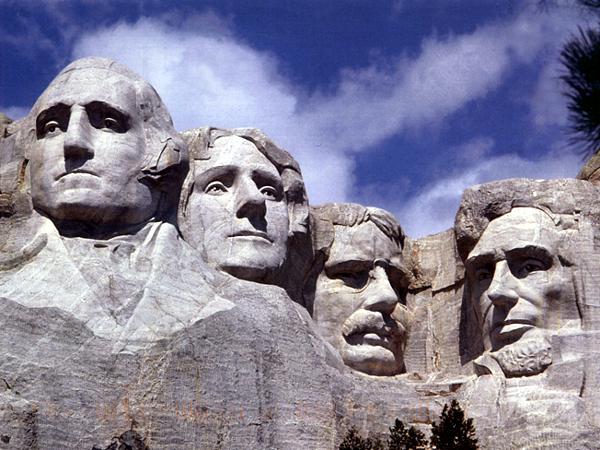
Mount RushmoreFew people who visit Mount Rushmore will forget the name of its designer, sculptor Gutzon Borglum. I’ve always chuckled at his odd name, while marvelling at his work.

Borglum created a number of pieces of public art. The one I’ve encountered most often, during the time I lived in the Washington, DC, area, is his statue of Civil War general Philip Sheridan, displayed at Sheridan Circle, at 23rd Street and Massachusetts Avenue, next to Rock Creek Park. His most famous, though, is Mount Rushmore.

The massive Mount Rushmore National Memorial, in the Black Hills of South Dakota, depicting the faces of four U.S. presidents, George Washington, Thomas Jefferson, Theodore Roosevelt, and Abraham Lincoln. The monument took fourteen years to finish, and the final bits of what we see today were actually completed by the artist’s son Lincoln — named after the president — in the months after Gutzon’s death in 1941. Much more had been planned for the sculpture (the presidents were supposed to be seen from the waist up), but time and money settled us on what’s there.

His next most well known involvement is in the sculpture at Stone Mountain, Georgia, near Atlanta. Cut into the face of the granite rock, above a nice park, are the figures of three Confederate heroes — Thomas “Stonewall” Jackson, Robert E. Lee, and Jefferson Davis — riding horses. Borglum worked on the Stone Mountain project from its first cut in 1923, and the carving of General Lee’s head was unveiled in 1924. But he abandoned the project because of arguments with those in charge, the project was taken over by others (Augustus Lukeman in the 1920s, and Walker Hancock and Roy Faulkner in the 1960s) who completely removed Borglum’s work and replaced it.

But his name will always be remembered for Mount Rushmore, probably the most impressive sculpture in the world, visited by around two million people a year.

Sunday, March 22, 2009

.

Church Windows

Union Church of Pocantico HillsYou wouldn’t think it, but the unassuming little church to the right (click to enlarge) houses some of the greatest art treasures of the Hudson Valley.

The church is the Union Church of Pocantico Hills, and it’s the small, neighborhood church that the Rockefeller family attended when they were at their “country home”. When you’re a Rockefeller, you can spend lots of money on anything you choose. And what the Rockefellers chose was to spend money making their church beautiful. In particular, to buy stained-glass windows for it.

They commissioned the windows, actually. From Henri Matisse and Marc Chagall; maybe you’ve heard of them?

Matisse was a friend of Abby Aldrich Rockefeller, and he did the rose window at the request of her son, Nelson (maybe you’ve heard of him, too: he was the U.S. Vice President for a while, under Gerald Ford). It was the last piece that Matisse did before he died.

The Chagall windows were done at the request of Nelson’s brother David, in memory of their father, John D. Rockefeller, Jr. They’d initially planned only the largest, The Good Samaritan (the one visible on the right side of the photo), which opposes Matisse’s rose window. In the end, though, Chagall did eight smaller windows, as well, four on each side of the church.

Read David Rockefeller’s recollection of the commissioning of the windows in the link above.

And they’re beautiful. I love the colours and the designs. Chagall is a favourite of mine, in general, and I stop and visit these windows once or twice a year.

You can, too: they’re open for viewing from April through December, church schedule permitting. If you’re in the area, they’re worth a stop. And you can take a walk in the nearby Rockefeller State Park Preserve.


[Classical music fans may recognize this entry’s title as the name of a set of pieces by Ottorino Respighi. Best known for his Pines of Rome set, Respighi wrote a number of thematic pieces for orchestra, including Fountains of Rome, Church Windows, Brazilian Impressions, and Ancient Airs and Dances.]

Wednesday, September 03, 2008

.

Storm King Art Center

Two sculptures by Mark di SuveroSome 45 minutes from where I live is the Storm King Art Center, a 500-acre outdoor sculpture museum. I went there with some friends on Saturday.

In contrast to the Grounds for Sculpture in New Jersey, which shows mostly smaller pieces, much of the art at Storm King is massive, really taking advantage of the expansive fields and the open sky.

Here’s a link to a satellite view of the park.Goldsworthy, 'Storm King Wall' Pan down, south, to the edge of the treeline, to see Storm King Wall, by Andy Goldsworthy, as it snakes through the trees. Zoom in and pan around the park, and you can see many of the huge sculptures, large enough to be visible in the satellite images.

I’ve posted some photos of my favourites to my Picasa album, and I’ve carefully geo-tagged them to get you right to the spot where the sculpture is (rather than to the spot I was standing when I took the photo).

If you’re in the area, the Storm King Art Center is definitely worth a visit.

Sunday, February 24, 2008

.

The Dinner Party

Judy Chicago's 'The Dinner Party'I’ve always wanted to see Judy Chicago’s enormous feminist-art piece, The Dinner Party, in person, having seen pictures and descriptions of it for many years. Yesterday, I got to the Brooklyn Museum, where it currently resides, in a long-term installation.

Ms Chicago conceived the work in the mid‘70s, but it actually took five years and a small army of artists to build it, completing it in 1979. The main portion of the installation is a large, triangular room with a large, triangular table. Each side of the equilateral triangle — representing equality and strength — has a place setting for 13 women, historical and legendary, who have contributed to the world as leaders, artists, scientists, writers, doctors, activists, etc. Each of the place settings also represents, by extension, many other such women, whose names are drawn on the tiles that form the platform under the table.

Each place setting consists of an embroidered runner with the honoree’s name and a design that connects to her, and a plate decorated with a design based on butterfly, flower, and vulva shapes, reminiscent of many of Georgia O’Keeffe’s flower paintings — and, in fact, Ms O’Keeffe is the 39th “guest” at Ms Chicago’s table.

Finishing out each place setting is a goblet, a napkin, and a set of flatware, the same for all 39 settings. The sameness, says the artist, represents the sameness with which women are treated, despite their uniquenesses and contributions.

Leading into the main room is a hallway with a set of embroidered banners that contain lines from a poem by Ms Chicago. After the main room, is a set of “historical panels” that list the women on the place settings along with the other names associated with each... it’s hard to read them from the floor tiles.

The Brooklyn MuseumThe whole installation is beautiful, fascinating, and powerful. I’m so glad I’ve finally had a chance to see it. And it’s accompanied by a 45-minute film narrated by Judy Chicago, in which she describes the design of each place setting and of the piece as a whole (I only had time to see part of the film on this trip, the part from Sojourner Truth to Georgia O’Keeffe). I aim to go again, and to allow about two hours just for this work alone.

If you live in the New York area, or if you get here for a visit, do make a trip to the Brooklyn Museum — easily accessed by subway — and see this, along with the rest of the museum’s excellent collection.

[And see the Brooklyn Museum web site for a 3-D virtual tour of The Dinner Party.]

Wednesday, October 31, 2007

.

Museum, museum

On Saturday, on a visit to the Berkshires in western Massachusetts, I stopped at two art museums there, for a couple of hours each:

  1. Sterling and Francine Clark Art Institute (The Clark), in Williamstown
  2. Massachusetts Museum of Contemporary Art (MASS MoCA), in North Adams

The Clark was a delight! From the design of the buildings to the artwork inside, I enjoyed it completely. The new building housed two special exhibitions: one of Gainsborough, Constable, and Turner, and one of eighteenth-century French painter Jean-Honoré Fragonard. In the original building is the permanent collection, including a good collection of impressionist and post-impressionist art — my favourite era — as well as important American artists such as Winslow Homer, Mary Cassatt, John Singer Sargent, and, Frederic Remington.

MASS MoCA was significantly less delightful. I’m a big fan of some types of modern art, but not the industrial sort of stuff that’s on display there, I’m afraid. You might remember my comments on the Dia Beacon museum from two months ago. MASS MoCA is rather similar, with “art” made from broken slabs of concrete, and from stacked-up box fans, with “art” presented as a video of the artist telling you that he hates his mother. There were some things of interest there — Spencer Finch’s What Time Is It on the Sun? is interesting, for instance — but overall, I was very disappointed, having wanted to visit this museum for quite some time. I’d expected it to be less like Dia Beacon, and more like MoMA (maybe because of the name, MoCA/MoMA). So, yes, very disappointed.

Of course, how could I not have checked out the web sites ahead of time, and known what to expect? D’oh!

Saturday, September 01, 2007

.

Is it art?

It’s a question that various friends and I have asked each other for years, and that I’ve recently had another conversation about. And it’s a thing that happens to one, when one gets into blogging, that everything becomes a seed for a blog entry — or maybe “spore” is the better metaphor, considering the blog more as a fungus than as a flower. But it’s really a combination of the recent conversation and a few items that I’ve seen lately that has moved me to turn the question out here.

Let’s start with the items, but we’ll not discuss them. I’ll just throw them out at you, and let you answer for yourself which of these are art:
The billboard made to look like what’s behind it.
The photos of figurines being shattered.
The figures made from sandwiches.

And now let’s back up.

I like a lot of “modern art”. Frequenting modern-art galleries puts me face to face with Picasso and Miró and Léger, with Kandinsky and di Chirico, with Magritte and Pomodoro.

It also throws Pollock and Rothko at me, and Gilbert & George, and Duchamp’s “Fountain”. I’m decidedly less fond of this lot than of those in the previous paragraph. Is it art to buy a urinal, sign it, and put it on a pedestal? Is it art to drip and throw paint on a canvas, willy-nilly? Is it art to paint cartoonish images of turds flying through the air?

Why do I like the surreal images of Miró and the abstract shapes and splashes of colour of Kandinsky, but see nothing at all in the paint trails of Pollock and find Rothko’s rectangles boring and uninspired?

People have various characterizations of why they think things are art or not:

  • Art is beautiful. (This one rather begs the question.)
  • Art “says” something, has a message.
  • Art takes skill.
  • Art is unique.
  • Art is whatever the experts say it is.
  • Art is whatever its creator says it is.
There are many more, of course. I’m fond of saying, jokingly, that art is something I can’t do, and so if I could do it... it’s not art.

In Beacon, NY, there’s a whole museum — the Dia:Beacon — full of stuff that I don’t consider very artistic. Try On Kawara, Robert Ryman, Fred Sandback, and Robert Smithson, as examples.

Of course, art isn’t just painting and sculpture. What sorts of photographs will we call “art”? Some certainly thought Andres Serrano’s photo of a crucifix in a glass of urine was art... and some most definitely did not. The same goes for some of Robert Mapplethorpe’s photos. Less controversially, I think most agree that Ansel Adams produced art. Now, if I take a photo and it looks really good... is it art? Is this photo art, or this one? How about this or this? I certainly took the last one, of the frozen trees, with a mind toward taking an artistic photo. Does that make it art?

And music? Mozart’s mature music is art, so we consider what he wrote at the age of five to be art too. Does that really make sense? It’s sometimes said that Vivaldi didn’t write 500 concertos, but one concerto 500 times. Those who say that clearly are questioning whether it’s art when you make it with a cookie cutter. At the other end of the musical, um, scale, is John Cage’s “4 minutes, 33 seconds” art? Or Stockhausen’s “Hymnen”, which sounds like someone tuning across a short-wave radio band, stopping on occasional bits of national tunes intermixed with noise? And then there’s Sepultura.

My recent conversation also got into the question of “folk art”, and the distinction between arts and crafts. Is a decorative serving bowl art? Do things like jewelry and smoking pipes and fabrics qualify? Are these art?

No answers here, just food for thought. My answers wouldn’t be the same as yours anyway. Please feel free to comment. Don’t expect that we’ll agree.

Ars gratia artis.

Thursday, April 05, 2007

.

A tale of two peoples

Two peoples are taking note this week of their releases from slavery.

My family is Jewish, and this week, with Passover, they, and Jews the world over, are commemorating the exodus from Egypt, thousands of years ago. It's an eight-day festival, but most know it primarily by the two ritual meals, the seders, on the first and second nights (this Monday and Tuesday). The table is filled with symbols, symbols of tears and bitterness, of toil, of rebirth and the sweetness of freedom. The ritual explains the symbols and tells the story, from the biblical book of Exodus, of the slavery and oppression, of the intercession by God, of the ten plagues that finally convinced the Egyptian Pharaoh to release the Jews, of their flight, their years in the wilderness, their receipt of the Ten Commandments.

And it's all told with a detachment that comes from the passage of thousands of years. It's told in a mixture of fact and legend while reclining over wine and an abundant meal, with laughter and song and a hide-and-seek game for the children... but designed so the children will remember the story and pass it on, and so it will never be forgotten.

African-Americans also look at their time in slavery as we all remember the assassination of Martin Luther King, Jr, this week in 1968. For those Americans the memory is more recent: slavery ended in the United States less than 150 years ago, and black Americans from my generation were the first not to have first-hand accounts of life as slaves. Wounds that new don't afford the luxury of rumination over wine and feasting. There's no detachment there. And this story, too, will never be forgotten.

Yesterday, on the anniversary of Dr King's death, NPR told us about Kara Walker, a black artist who, working in cut-out silhouettes, has created a show of sometimes disturbing images that make us all think about how it was 150 years ago and more.

Her show, “Kara Walker: My Complement, My Enemy, My Oppressor, My Love”, is on display now in Minneapolis. It's going to Paris after that, and then New York City and Los Angeles. This won't be Ms Walker's first time showing in New York: here's a review of her 2006 show at the Met. This new show will be at the Whitney Museum from 11 Oct to 3 Feb, and I plan to see it there.

Saturday, March 31, 2007

.

New “blasphemy” in art

We had the Andres Serrano photograph of a crucifix in a glass of urine, which caused a stir in the '80s and early '90s.

We had the Chris Ofili work, where he decorated a painting of a black Madonna with elephant dung (search for the artist's name in the article), which caused a stir in 1999.

Now we have a statue of Jesus. With genitalia. Made out of milk chocolate. The statue's title is “My Sweet Lord” (really, you can't make this stuff up), and it was scheduled to be unveiled Monday, at the beginning of the Catholic Holy Week.

But, as the article says, the venue gave in to the pressure and pulled the piece (as it were).

The reaction “is crystal clear and has brought to our attention the unintended reaction of you and other conscientious friends of ours to the exhibition,” Knowles wrote in the two-paragraph cancellation notice.

Matt Semler, the gallery's creative director, resigned in protest.

Art is a very subjective thing....

Thursday, January 04, 2007

.

Where have you been, my blue-eyed son?

This week's mini-travel photos have left a few wondering whither I've been mini-travelling. Well, Monday's photo is of the Mormon temple in Kensington, MD, taken from the outer loop of the Capital Beltway. Tuesday's photo is of the National Museum of the American Indian. And Wednesday's shot is of the Phillips Collection buildings. I've had a quick spin through some museums in Washington, DC.

I lived in the DC area for eleven years, ending in 1988, and I like to go back when I can and re-visit its museums and galleries — and visit its new ones for the first time. New York has lots too, of course, but I have a particular fondness for the ones in DC. The core of the museum area is The Mall, the rectangle between the US Capitol and the Washington Monument, bordered by Constitution Avenue and Independence Avenue. There reside the National Museum of American History (currently closed for renovation), the National Museum of Natural History, the National Gallery of Art, the Hirschhorn Museum, the National Air and Space Museum, and others. Nearby are the National Portrait Gallery and the American Art Museum, which share a building that reopened last year after renovations, the Renwick Gallery, the Corcoran Gallery, and many others.

The newest museum on the mall is the National Museum of the American Indian, a beautifully designed building of flowing curves and inviting spaces. It opened in September 2004, and I haven't had a chance to visit it until now. Don't miss this one, now that the crowds have settled down and admission is open. And don't miss having lunch in the cafeteria, which serves foods inspired by native cooking, grouped at serving stations by region.

There are three permanent exhibits:

  • Our Peoples, looking at the different indigenous peoples throughout the Americas, from northern Canada to southern Chile,
  • Our Lives, considering how the native peoples maintain their traditions and coexist with the rest of the 21st-century world, and
  • Our Universe, focusing on native cosmology, traditional beliefs in the stars, the wind, and the land, and teaching us about their people's spiritual relationship with the natural world.
There's a fourth, changing exhibit; the one we saw is just ending, a detailed look at the lives of the peoples of the Pacific Northwest, from the Coast Salish of Oregon and Washington to the Tlingit of Alaska.

Next stop was the National Museum of African Art, along with a brief pass through the Sackler Gallery. Both are underground, and are accessed by entrance lobbies in the garden in front of “The Castle” — the Smithsonian Institution's visitor center.

The National Museum of African Art features carvings and everyday objects from sub-Saharan African tribes throughout the continent. Of particular interest to me is Body of Evidence, a changing exhibition of contemporaty African artists. Look at these wondeful pieces:

Finally, a visit to the Phillips Collection to see the wonderful exibition, “The Société Anonyme: Modernism for America”, which will only be there for another two weeks. This exhibition is worth a trip to DC! The Phillips's permanent collection is impressive (the most famous work in it is Renoir's The Boating Party), but this special exhibition is truly exciting. It heads to the Dallas Museum of Art next, in June.

The Société Anonyme collection includes some fabulous works by Kandinsky, Miró, Picasso, Man Ray, and other famous names. The highlights for me (look for them in the exhibit's Flash show) are:

  • Woman at the Card Table by Finnur Jónsson
  • Metaphysical Interior by Georgio di Chirico
  • The Red Cat by Heinrich Campendonk
  • At the Piano by Nadezhda Udaltsova
  • Brooklyn Bridge by Joseph Stella
  • Abstraction No. 3 by Lawren Stewart Harris

A nice whirlwind trip!

Saturday, November 18, 2006

.

Ain't technology wonderful? — college version

The University of Southern California has a new degree program. Students there can now major in "interactive entertainment", and other universities, including Carnegie-Mellon University, Southern Methodist University, and Georgia Tech, have already done the same. One thing that's interesting here, though, is that it's not a branch of computer programming, but is in the liberal arts program.

What makes that interesting is that the focus is not on the technology of the games, but on the games as an art form. The program is offered through the School of Cinematic Arts, and in reference to whether video games are "art":

[...] associate professor Tracy Fullerton looks back to 1929, when USC founded the first film school in the country. At the time, no one thought movies were serious art. "And now, of course, we recognise it as a powerful art form from the past century. I think we're looking at games and interactive entertainment and seeing that these can be the most powerful medium for the coming century."

And indeed, for a while now games have been released alongside movies, to co-market each other. Just take a look at the Internet Movie Database and see how often actors appear in movies and their corresponding video games (examples: each of Peter Jackson's "Lord of the rings" movies has a corresponding video game).

But beyond that, looking at the games as art, and putting in an academic environment, rather than a commercial one, encourages the development of games outside the commercial norm, and, in particular, departing from some of the violence of the commercial games:

It's about creating a game experience that is not typically aggressive and competitive.

Technology continues to change the world. It'll be interesting to see where degree programs such as this — and the graduates of them — go over time.

Saturday, August 26, 2006

.

Grounds for Sculpture

'Were You Invited?', by J. Seward Johnson, at the Grounds for SculptureThe Grounds for Sculpture, near Trenton, NJ, has to be the best-kept secret on the east coast. I heard about it a few years ago from a friend in California (yes, that's right), and everyone around here I've told about it had never heard of it before either. And what a pity that is: it's a wonderful place!

Founded by artist J. Seward Johnson, the sculpture park opened in 1992. It now comprises 35 acres and some 170 works of modern sculpture. The styles vary from abstract to minimalism to realism. There's something for everyone there, and the grounds are marvellously landscaped. Around every corner, amid every copse, behind every bush is something to be discovered. As one drives to the park, sculptures line the roads, leading the way and heralding the pleasures inside the gates. Several of Johnson's own works are there, of course; his theme is sculpted realizations of classic impressionist paintings. Hidden behind some bushes is his version of Manet's Le déjeuner sur l'herbes, and the Where's-Waldo–esque photo to the upper right (click to enlarge and find the bit that's out of place) was taken in his 3-D rendition of Renoir's Luncheon of the Boating Party.

The web site will lead you through the park's permanent collection, and if that's not enough to entice you to visit, take my word for the delightfulness of the setting — it's a great way to spend a temperate, sunny day (though I've been there in the rain too, and, you know, that's also nice). There's also a nice restaurant in the park, alongside a pond, with a garden and a view of their re-creation of Monet's Le pont japonais à Giverny — and with a decent selection of beers and wines.

If you're somewhere in the northeast, this place is worth a special trip. I've been there a few times, and I'd probably be there weekly if it were closer to me. With a two-hour drive to get there, I only go once or twice a year.

Sunday, August 13, 2006

.

Donald M. Kendall Sculpture Garden

Donald M. Kendall Sculpture Gardens brochure and mapI've lived here for 18 years. I never knew about the Donald M. Kendall Sculpture Garden on PepsiCo's world headquarters campus, until last week. The other day, I paid it a visit. (Click the image of the brochure for the map of the grounds.)

What a lovely place, and how lucky those who work there are to have such a thing right outside their office buildings! Thirty-five 20th-century sculptures ring the building, and ten smaller ones reside in the central courtyard. The campus is landscaped with ponds, streams, fountains, trees, grasses, and lilies, and the courtyard's art is mixed with shrubs, small trees, and pools.

And the artwork is wonderful! These are not insignificant pieces by unknown artists or the CEO's nephew. The list is a "who's who" of 20th-century sculptors: Alberto Giacometti, Henry Moore, Alexander Calder, Claes Oldenberg, Max Ernst, Jean Dubuffet, Joan Miró, and Auguste Rodin, to name a few. And the landscaping is as much a work of art as the sculpture is. There's a copse of trees that looks like it should have a horse and rider interleaved in it, as in Magritte's painting "Le Blanc-Seing". It doesn't get much better than this, and it's free for anyone who wants to wander. One needn't so much as buy a Pepsi to see it.

Ah, if I worked there I'd be taking that walk every day at lunch, or in the morning before work. As it is, I'll be back for many more visits.