Showing posts with label Music. Show all posts

Wednesday, January 11, 2012

.

What’s that rhyme?

Now that I have the file-count limit sorted out on the audio system in my car, it’s much better at playing songs in random order. Now I’m hearing Yes, Linda Ronstadt, Steely Dan, Toni Price, and Jackson Browne, and not just artists in the alphabetic A’s and B’s.

Thus, the other day I heard a song from Los Lobos’ great album The Neighborhood. The song that came on was the one that opens the album, Down on the Riverbed, and it struck me, as it has before, that there’s a slight oddness to the rhyme in the chorus. It goes like this (emphases mine):

Down on the riverbed,
I asked my lover for her h...

...for her h...

You want it to be head, don’t you? I certainly do. They set you up with bed thrice, and what rhymes with bed? Well, head, most assuredly.

Of course, it’s hand; Down on the riverbed, I asked my lover for her hand.

Trips my brain up every time I hear that song.

Tuesday, November 29, 2011

.

Stan and George

Today gave us one great musician, and took away another, both of whom I’ve written about in these pages before. Canadian singer/songwriter Stan Rogers was born on this day in 1949. English singer/songwriter George Harrison died ten years ago today. Go back to my earlier posts for my comments about them. Here, just a quotation or two from their songs.

Watch the field behind the plow
Turn to straight, dark rows
Feel the trickle in your toes
Blow the dust-cake from your nose
Hear the tractor’s steady roar
Oh, you can’t stop now
There’s a quarter section, more or less, to go

And it figures that the rain
Keeps its own sweet time
You can watch it come for miles
But you guess you’ve got a while
So east the throttle out a hair
Every rod’s a gain
And there’s victory in every quarter mile

— Stan Rogers, The Field Behind the Plow, 1981

Don’t have to be ashamed of the car I drive
        [The end of the line]
I’m just glad to be here, happy to be alive
        [The end of the line]
It don’t matter if you’re by my side
        [The end of the line]
I’m satisfied

Well it’s all right, even if you’re old and grey
Well it’s all right, you still got something to say
Well it’s all right, remember to live and let live
Well it’s all right, the best you can do is forgive

Well it’s all right, riding around in the breeze
Well it’s all right, if you live the life you please
Well it’s all right, even if the sun don’t shine
Well it’s all right, were going to the end of the line

— George Harrison, et al, The End of the Line, 1988

Sunday, November 27, 2011

.

Happy birthday, Jimi Hendrix

Jimi Hendrix was born on this day in 1942, in Washington — the state, not the city. He died far too young, at 27.

And so castles made of sand
Fall in the sea
Eventually

— Jimi Hendrix, 1967

Saturday, August 13, 2011

.

Bird-Mountain

Daniel Grayling Fogelberg would have turned 60 today, had he not left us at the age of 56, taken by prostate cancer. His home town, Peoria, Illinois, dedicated a memorial garden to him in its Riverfront Park last year.

I first came across Dan Fogelberg’s music with his second album, Souvenirs, in 1974 — it’s playing on my stereo as I write this. His subsequent Captured Angels and Nether Lands stay together in my mind as my two favourites; I can’t choose between them. He’s probably best known, though, for songs from Phoenix and The Innocent Age.

This song, which he wrote for his father and recorded on The Innocent Age, seems appropriate to dedicate to Dan today:

I thank you for the music and your stories of the road.
I thank you for the freedom when it came my time to go.
I thank you for the kindness and the times when you got tough.
And, papa, I don’t think I said I love you near enough.

The leader of the band is tired and his eyes are growing old,
But his blood runs through my instrument and his song is in my soul.
My life has been a poor attempt to imitate the man.
I’m just a living legacy to the leader of the band.

— Dan Fogelberg, from Leader of the Band

Tuesday, May 24, 2011

.

70 Bob

Today is the birthday of, among others, Robert Zimmerman, who turns 70.

70.

Geez.

To everyone with a birthday today:

May God bless and keep you always
May your wishes all come true
May you always do for others
And let others do for you
May you build a ladder to the stars
And climb on every rung
May you stay forever young

May you grow up to be righteous
May you grow up to be true
May you always know the truth
And see the lights surrounding you
May you always be courageous
Stand upright and be strong
May you stay forever young

May your hands always be busy
May your feet always be swift
May you have a strong foundation
When the winds of changes shift
May your heart always be joyful
And may your song always be sung
May you stay forever young

— Bob Dylan, 1974

Sunday, May 01, 2011

.

First of May

A favourite of mine, from way back:

When I was small and Christmas trees were tall
We used to love while others used to play
Don’t ask me why, but time has passed us by
Someone else moved in from far away

Now we are tall and Christmas trees are small
And you don’t ask the time of day
But you and I, our love will never die
But guess we’ll cry come first of May

The apple tree that grew for you and me
I watched the apples falling one by one
And I recall the moment of them all
The day I kissed your cheek and you were gone

Now we are tall and Christmas trees are small
And you don’t ask the time of day
But you and I, our love will never die
But guess we’ll cry come first of May

— B., R., & M. Gibb, 1968

Wednesday, March 30, 2011

.

Clapton is God!

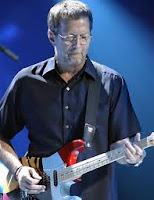
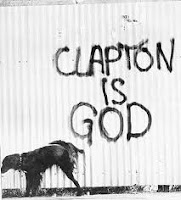
Eric ClaptonClapton is GodI’m at the IETF meeting in Prague this week, so there’s little blogging to be done. But I wanted to note that Eric Clapton turns 66 today, and to give you two of my favourites of his performances. Enjoy.

Friday, March 25, 2011

.

Happy Eltonmas

Today is Sir Elton John’s birthday; he’s 64. Here are two of my favourites of his songs. Enjoy the next eleven and a half minutes.

Wednesday, December 08, 2010

.

Fever

That’s the good kind of fever.

Right now, I have the bad kind of fever, the kind where you wake up in the middle of the night and wonder whether the heat will turn your brain into a rutabaga, and hope that the fact that you’re thinking that means it won’t.

And I have two days of meetings at my company’s U.S. headquarters in Santa Clara, CA. I bet the folks I’m meeting with will be just delighted at my hacking cough and my nose blowing, yes, indeedy.

Friday, October 01, 2010

.

On compression and sound quality

Actor and filmmaker Adrian Grenier was on a local radio talk show the other day. As an addendum to the show, they posted a brief Q&A on the web, in which he says this:

Q: What are you listening to right now?

A: I just reunited with my record collection. Records sound better than MP3’s. I was just listening to Toots and the Maytals on vinyl.

Now, there’s certainly been a lot of debate about whether analogue sounds better than digital, when it comes to recorded music. When you hear live music, the vibrations reach your ears, your ears pick them up and send them to your brain through your nerves, and you hear exactly what someone sitting at that spot (and with your hearing capabilities) will hear. It’s perfect, in the sense that you can’t get more like really being there than... really being there.

Any recording provides a different experience, and whether that experience is better than the live one depends upon a lot of things, including where you were sitting and where the microphones were, how much extraneous stuff was heard by each (you and the microphones), and so on... along with the social experience and energy of being there to see it.

That said, there have always been those who say that digital recordings sound digital, changing the sound in unpleasant ways. Music is recorded on a CD, for example, by sampling the actual sound at frequent intervals (about 44,000 times a second), and by encoding the sampled sounds as numerical values (16-bit numbers, for CDs). The choice of the frequency of the sampling and the number of values (number of bits) used in the encoding affects the maximum quality of the sound.

I’m not going to get into the debate, here, and I’ll only note that since CDs have given way to other ways of listening, we’ve increased both the sampling rate and the number of bits per sample in some recordings. Whether or not CDs sound good, there’s better digital source material out there.

MP3 files, though, are not original source material: they’re compressed from the original, and their quality can vary greatly. Let’s look at why.

Broadly, there are two kinds of compression: lossless, and lossy. We use lossless compression in computer work all the time, such as when we make ZIP files. To do compression losslessly, we take advantage of redundancies, repetitions, and nearness that show up naturally in data, use alternative representations for common sequences, and that sort of thing. Any lossless compression algorithm works best on the kind of data its designed for, and doesn’t work well on certain other kinds.

Here, for instance, is a lossless algorithm I’m making up as I type this, designed for compressing English text, text consisting of letters, numbers, and a few punctuation marks and symbols:

In normal English text (US-ASCII), each character is represented by one byte. We know that the most common 11 letters in English are, in order, e, t, a, o, i, n, s, h, r, d, and l. So we’re going to represent each of those, plus the space character, with a half-byte instead of a full byte (shown here in binary, for clarity):

0000 = (space), 0001 = e, 0010 = t, 0011 = a, 0100 = o, 0101 = i,
0110 = n, 0111 = s, 1000 = h, 1001 = r, 1010 = d, 1011 = l

That leaves 15 lower-case letters, 26 upper-case letters, and 10 numerals to be represented, and we can introduce one-byte patterns with a half-byte of the form 11xx, unused above. We’ll reserve 1100 0000 for now, and assign the remaining one-byte patterns (11xx xxxx, where the x’s are not all zeroes) arbitrarily to those characters and two the 12 most common punctuation marks:

1101 0000 = b, 1101 0001 = c, 1101 0010 = f, 1101 0011 = g, ...,
1100 1111 = z, 1101 0000 = A, 1101 0001 = B, 1101 0010 = C, ...,
1110 1001 = Z, 1110 1010 = 0, 1110 1011 = 1, 1110 1100 = 2, ...,
1111 0011 = 9, 1111 0100 = (comma), 1111 0101 = (period), .....

Finally, we’ll represent anything else by using our reserved 1100 0000 as an escape, so that the byte immediately following it represents its normal US-ASCII value:

1100 0000 0010 0100 = (dollar), 1100 0000 0010 0101 = (percent),
1100 0000 0010 0110 = (ampersand), ....

Therefore, our system represents the space and the eleven most common letters in half the normal number of bits (4), and the remaining letters and numerals, along with twelve punctuation marks, in the normal number of bits (8)... but takes twice the number of bits (16) to represent anything else. It would be horrible for music files, which are made up of arbitrary binary data and which would get much bigger if put through this compression. But for plain English text, here’s an example, using hexadecimal notation to be more concise:

Original: This is a compressed string.

US-ASCII: 54 68 69 73 20 69 73 20 61 20 63 6F 6D 70 72 65 73 73 65 64 20 73 74 72 69 6E 67 2E

Our algorithm: E3 85 70 57 03 0C 24 C7 C8 91 77 1A 07 29 56 C4 F5

We’ve reduced the string from 28 bytes to 17, and it’s fully reversible (once we’ve dealt with padding needed when we end in the middle of a byte, but that’s easy enough and we don’t need to get into that here).

OK, that was fun to play with, but what about compressing music?

We can’t rely on common byte values for music, because the value of a given sample can be anything — silent, super-loud, or somewhere in between. But we can rely on the fact that in normal music, sounds don’t come in and go out instantaneously, and, therefore, adjacent samples are most likely to be relatively close to one another. If we optimize the algorithm for aspects like that, we can get fairly efficient compression. We can even get lossless compression to a point.

For example, suppose we’re using 32-bit samples, but we say that if we have a 32-bit sample and the next sample is within 15 bits of that one, we can instead use a 16-bit value that represents plus (first bit 0) or minus (first bit 1) from the reference sample. The next sample could similarly be coded as a delta from the second, and so on. We’d have to do some futzing around to signal that we’d gone back to a full 32-bit sample again, and we’d probably want to do that periodically, whether we need to or not, to set up resync points in case something goes wrong with the data streaming. But this is not an ideal nor complete mechanism... just the beginnings of an example.

But for the high levels of compression that we need to use to turn music or video into tolerably sized files, we need to go for lossy compression methods. That means that we can’t turn the compressed file back into the full version, because some information has been lost in the process. And information loss means quality loss — the compressed file is no longer a faithful copy of the original, and any playback is measurably different from the original.

But is it noticeably different from the original?

That, of course, depends upon how sensitive one is. Still, while the difference between CDs and vinyl records could be (and was) hotly debated, this one’s pretty straightforward: the difference is, in general, discernible on good equipment. There are a lot of compromises on the way from ten megabytes or more per minute to one megabyte or less per minute. That heavy compression is what makes it possible for us to put entire music collections in our pockets, so it’s worth it to many.

And when we’re putting the music in our pockets and listening to it with ear buds as we ride the subway and walk down noisy streets, we’re not noticing the digital and compression artifacts, the reduced frequency range, the lower sound quality. It’s entertaining us and keeping the world of chatty commuters and jackhammers and car horns way.

With docking stations, though, we’ve brought that model into our living rooms, and we’re often listening to MP3 files at home, through loudspeakers the size of a paperback book. Where we used to show off audiophile equipment stacked up on shelves and massive speakers that dominated the room and rattled the walls with great sound, we’re now boasting about how compact it all is.

It’s compact, though, at the cost of sound quality, and Adrian Grenier is going back to vinyl.

Saturday, September 18, 2010

.

40 years after Jimi

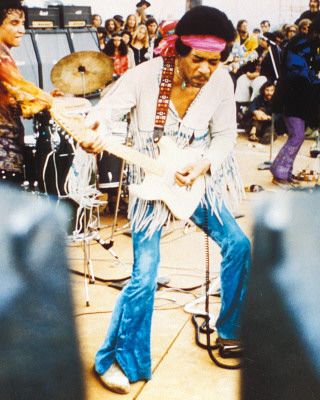
Jimi Hendrix at WoodstockJohnny Allen Hendrix, was born in Seattle in 1942. Legendary psychedelic-blues/rock guitarist Jimi Hendrix died in London 40 years ago today, at the age of 27.

Maybe you liked Hendrix’s music, or maybe you thought it was just so much distorted noise. Either way, there’s no arguing that he created new ways to play an electric guitar. He used reverberation, distortion, and feedback, not as accidental or undesirable artifacts, but as part of the music he made. Wah-wah, tremolo, phasing effects, and simply striking the guitar to create crashing sounds were all part of it as well. In Jimi Hendrix's hands, an electric guitar became more than just an amplified guitar.

And, of course, it was loud. Sample his version of The Star-Spangled Banner from the close of the 1969 Woodstock weekend.

The Jimi Hendrix Experience only released three studio albums during his lifetime, in 1967 and ’68, but he recorded a lot of material and a number of records came out years after his death.

Why not sit back this afternoon, and soak in some Purple Haze, The Wind Cries Mary, Castles Made of Sand, or Electric Ladyland?

Purple haze all in my eyes
Don’t know if it’s day or night
You’ve got me blowin’, blowin’ my mind
Is it tomorrow or just the end of time?

Monday, September 06, 2010

.

Hike of the week: Storm King

The view north from Storm King Mountain

The view north from Storm King Mountain on Saturday.

Dar Williams playing in Cold Spring, NY

And a free Dar Williams concert at the gazebo in Cold Spring on Sunday.

Monday, August 16, 2010

.

Blogging songs?

On the radio program Soundcheck today, they had singer/songwriter Jonathan Mann as a guest. Mr Mann started writing a new song every day on the first of 2009, and he’s continued it since — he performs each song, and posts a video of it to YouTube. (His web site is here, and his song-a-day project is here.)

This reminds me of my blogging goal of writing a post in these pages every day. In a number of ways, it’s similar, though Mr Mann not only writes, but also performs and makes the video. He, too, watches the news of the day, and often takes his material from news items (he recently did one on flight attendant Steven Slater, as did I; his is not safe for work). I’d say he’s more entertaining than I am: you do not want to hear me sing.

I like his approach, and I’ll be interested to see how long he wants to keep up the one-a-day pace.

His song for yesterday, day 591, is about the Tea Party nuts. You should definitely go have a listen to that one. Here’s the chorus:

And the hate builds up
And Glenn Beck cries
Ann Coulter rants and raves
And O’Reilly screams

You ain’t never gonna reason with these folks
They think that Obama was born in Kenya
Ain’t never gonna reason with these folks
They think Sarah Palin would make a great president
Ain’t never gonna reason with ’em

Thursday, July 15, 2010

.

Happy birthday, Linda

Album cover of 'Humming To Myself'Linda Ronstadt turns 64 today — she was born on this day in 1946 in Tucson.

She began as a country/pop crossover singer, but has, over her career, dipped into many streams, doing big band standards (with the late Nelson Riddle), Latin standards, soul-pop (with Aaron Neville), punk (covering Elvis Costello and others), Gilbert and Sullivan, mariachi and tejano, and other styles. The variety in her music has been something that’s kept me interested over the many years of her career.

Ronstadt’s sung many songs of two of my favourite songwriters, Karla Bonoff and Warren Zevon. She’s collaborated with pretty much everyone in the music business. In her personal life, she’s noted for her relationship with former California governor (and now attorney general) Jerry Brown, and her engagement to movie producer and director George Lucas... but she’s never married. She’s adopted two children, a boy and a girl, both teenagers now. She’s an activist for such causes as gay rights and environmental issues, and is an advocate for immigrants and for the arts.

Happy birthday, Linda, and thanks for entertaining me since I was your son’s age.

Saturday, July 03, 2010

.

When the music’s over, turn out the lights

39 years ago today, Jim Morrison died in Paris. He was the third top rock musician to die at the same age — 27 — in less than a year (Jimi Hendrix died in London the previous September, and Janis Joplin died in Los Angeles a few weeks after that). Morrison would probably have thought there was something mystic about 27, and would have written a poem about it.

Not to touch the earth
Not to see the sun
Nothing left to do, but run, run, run
Let’s run
Let’s run
House upon the hill
Moon is lying still
Shadows of the trees
Witnessing the wild breeze
C’mon baby run with me
Let’s run

Part beat poet, part musician, part performer, part exhibitionist, part introvert, and all, as he saw it, misunderstood, Jim Morrison was probably the most eccentric, enigmatic, and charismatic rock-music figures of the late 1960s.

Well, your fingers weave quick minarets
Speak in secret alphabets
I light another cigarette
Learn to forget

His death was as enigmatic as his life: there was no autopsy, and the cause of his death has never been known for sure, leading to endless speculation.

I was doing time in the universal mind
I was feeling fine
I was turning keys, I was setting people free
I was doing all right

Jim Morrison’s grave is in Paris’s Père Lachaise Cemetery. His long-time girlfriend, Pamela Courson, who was the one who found him dead, herself died of a heroin overdose in 1974... at the age of 27.

The music is your special friend
Dance on fire as it intends
Music is your only friend
Until the end

Friday, July 02, 2010

.

Licenses for music venues

I’ve been hearing a few things, lately, about a push that the music industry is making to require places that host live-music events to have licenses for the music that’s played there. Here’s an article about it in the Boston Globe, and here’s a radio program that has the article’s author as a guest to talk about it.

The issue here is that if musicians play copyrighted music at a live venue, and the musicians who are performing don’t own the copyright, then the venue — not the musician, or maybe in addition to the musician — is responsible for any copyright violation. And when the copyright owners are the performance rights organizations (such as ASCAP and BMI), they are aggressively enforcing the rule, going out to small venues and shaking them down. To avoid trouble, these small venues — coffee houses, local libraries, and the like — have to fork out around $300 to each organization each year, just in case someone plays a song owned by that organization.

At one level, this sounds good: if I play your song at one of my performances, you should be paid for it. There are some problems with that, though. For one thing, if I’m playing your songs, it should be I who has to have a license from your company. It doesn’t seem that the venue should be responsible for that. For another, as you might expect, it’s mostly the PROs and the major songwriters who benefit from this. Small songwriters — the ones we’d all like to see get their due — get almost nothing from it, because, of course, the PROs have no way to know when someone happens to play your song in the South Salem Library in New York. They distribute the money based on expected balance, and a singer is much more likely to perform a cover of, say, an Eagles song than of one of yours.

Some venues have tried to insist that their performers do only original material, but they’re still getting strong-armed by the PROs, which say — correctly, I suppose — that the venue can’t be sure that the performers are complying with the demand, and if they might play covers, the venue needs to be covered.

That’s prompted some small places to stop having music, and that’s a sad thing. And I wonder where it ends. Square dance callers, who use recorded music and often call dances in school gyms and church social halls, have long had to have BMI and ASCAP licenses. But will the halls now have to get licenses as well? If so, will they refuse to rent their facilities to events such as those, which use copyrighted music? Whom does that benefit?

As I see it...

  1. Demanding that both the performers and the venues have licenses from the PROs is abusive.
  2. For the most part, performers should be the ones to get the licenses, since it’s they who are performing the copyrighted material, and they who are making the choice.
  3. In cases where venues need to be licensed, small venues such as local coffee shops and libraries should be exempt.
  4. If performers say they’re only performing their own material, no one should be expected to hold any licenses. Enforcement of this is as enforcement of anything else like it: the PROs will have to do spot checks, and challenge violations. They can’t be allowed to collect from everyone, just in case.
  5. There needs to be a way for a performer to make sure the writers of the songs he sings are the ones who get paid from his license money. If I only ever cover songs by Bill Staines, say, then I don’t want Metallica getting my license fees.

Wednesday, June 02, 2010

.

Stan Rogers

Stan Rogers, Canadian singer and songwriter, died in an airplane fire on this day in 1983, while returning to Canada from a performance in Texas. He was only 33 years old.

Stan’s music was classified as “folk”, and tended toward maritime style, stories of farmers, and times out of Canada’s past. “Northwest Passage”, “The Field Behind the Plow”, and “Lies” are among his best-known songs.

Since Stan joined the too-long list of musicians who left us before they should have, his younger brother Garnet has been reminding us of Stan’s music, as well as giving us his own style, more rock-and-blues oriented.

Listen to “Lies” here, and read it here:

At last the kids are gone now for the day
She reaches for the coffee as the school bus pulls away
Another day to tend the house and plan
For Friday at the Legion when she’s dancing with her man
Sure was a bitter winter but Friday will be fine
And maybe last year’s Easter dress will serve her one more time
She’d pass for twenty-nine but for her eyes
But winter lines are telling wicked lies

All lies, all those lines are telling wicked lies
Lies, all lies. Too many lines there in that face
Too many to erase or to disguise, they must be telling lies

Is this the face that won for her the man
Whose amazed and clumsy fingers put that ring upon her hand
No need to search that mirror for the years
The menace in their message shouts across the blur of tears
So this is beauty’s finish, like Rodin’s “Belle Heaulmière”
The pretty maiden trapped inside the ranch wife’s toil and care
Well, after seven kids, that’s no surprise
But why cannot her mirror tell her lies

All lies, all those lines are telling wicked lies
Lies, all lies. Too many lines there in that face
Too many to erase or to disguise, they must be telling lies

Then she shakes off the bitter web she wove
And turns to set the mirror, gently, face down by the stove
She gathers up her apron in her hand
Pours a cup of coffee, drips Carnation from the can
And thinks ahead to Friday, ’cause Friday will be fine
She’ll look up in that weathered face that loves hers, line for line
To see that maiden shining in his eyes
And laugh at how her mirror tells her lies

All lies, all those lines are telling wicked lies
Lies, all lies. Too many lines there in that face
Too many to erase or to disguise, they must be telling lies

— Stan Rogers, “Lies” (1980)

Friday, May 14, 2010

.

Happy birthday, Jack Bruce

On this day in 1943, the bass guitarist, singer, and composer Jack Bruce was born in Scotland.

Jack Bruce is best known for his work with Eric Clapton and Ginger Baker in the “supergroup” Cream, in the late 1960s. Along with lyricist Pete Brown, with whom he frequently collaborated, he wrote several of Cream’s most popular songs, including “Sunshine of Your Love”, “White Room”, and “I Feel Free”, and he did the vocals on the group’s recordings and performances of them.

In the early 1990s, Jack Bruce reunited with Ginger Baker and, adding guitarist Gary Moore, formed an excellent but short-lived trio called BBM. They produced one album, “Around the Next Dream”, and Bruce and Moore co-wrote three of the best songs on that album. A lyric from the opening track, “Waiting in the Wings”, gives the album its title. The song’s immediately catching, with a great guitar riff, and vocals by Bruce:

She was standing in the dark, waiting in the wings,
Just around the next dream.
She was holding all the keys to set my heart free,
Behind the shadows of love.

From the distance I could see her standing alone,
Shine like a jewel in the night.
Hidden from the eyes, a thief of the soul,
Behind the shadows of love.

Set me on fire with the stories you tell,
Drown in an ocean of dreams.
Close to the flame on wings of desire,
Nothing’s what it seems.

She was waiting outside with arms open wide,
Ready to break my heart’s fall.
Oh, the lightning in her eyes, I learned how to fly
Behind the shadows of love.

Set me on fire with the stories you tell,
Drown in an ocean of dreams.
Close to the flame on wings of desire,
Nothing’s what it seems.

Sunday, April 04, 2010

.

Easter Parade

In your Easter bonnet,
With all the frills upon it,
You’ll be the grandest lady in the Easter parade.

I’ll be all in clover,
And when they look you over,
I’ll be the proudest fellow in the Easter parade.

On the avenue,
Fifth Avenue,
The photographers will snap us,
And you’ll find that you’re in the rotogravure.

Oh, I could write a sonnet
About your Easter bonnet,
And of the girl I’m taking to the Easter parade.

— Irving Berlin

Sunday, January 24, 2010

.

Warren Zevon

Singer/songwriter Warren Zevon was born on this day in 1947.

Well, I’m sitting here playing solitaire
With my pearl-handled deck
The county won’t give me no more methadone
And they cut off your welfare check

Carmelita, hold me tighter
I think I’m sinking down
And I’m all strung out on heroin
On the outskirts of town

— “Carmelita” (1974)

Album cover for 'Excitable Boy'I first knew Warren Zevon’s music from Linda Ronstadt’s covers: she sang four songs that he included on his 1976 album (“Hasten Down the Wind”, “Mohammed’s Radio”, “Carmelita”, and “Poor Poor Pitiful Me”), an album I didn’t know until Excitable Boy came out in 1978. My cousin played both albums for me, and I was immediately smitten by the poetry, the socio-political commentary, the offbeat subject matter that sometimes went to the macabre (as in the title song of the 1978 album), and Zevon’s voice, which seemed perfect for his material.

I’ve always liked those two albums the best, and I’m not sure whether it’s because they were my introduction to his music. When he released Bad Luck Streak In Dancing School, I saw him perform at George Washington University’s Lisner Auditorium. It was a great concert, and somewhere I have a bunch of slides that I took with my camera. One day, I’ll find someone with a slide scanner and I’ll digitize them.

She’s so many women
He can’t find the one who was his friend
So he’s hanging on to half a heart
He can’t have the restless part
So he tells her to hasten down the wind

— “Hasten Down the Wind” (1975)

Bad Luck Streak In Dancing School had some good songs, as did his next studio album, The Envoy, but neither did as well as the others... and then he took a nose-dive, fired by his record label and descending into alcoholism and drug abuse. He eventually kicked the problems and came back with Sentimental Hygiene and a series of subsequent records, but I’ve just stuck with what he did on Asylum Records, and that’s how I’ll always remember his music.

Warren Zevon, who titled a song from his 1976 album “I’ll Sleep When I’m Dead”, went to sleep on the 7th of September, 2003, at the age of only 56.

I was gambling in Havana
I took a little risk
Send lawyers, guns and money
Dad, get me out of this

I’m the innocent bystander
Somehow I got stuck
Between a rock and a hard place
And I’m down on my luck

— “Lawyers, Guns, and Money” (1977)