From the beginning of the trip: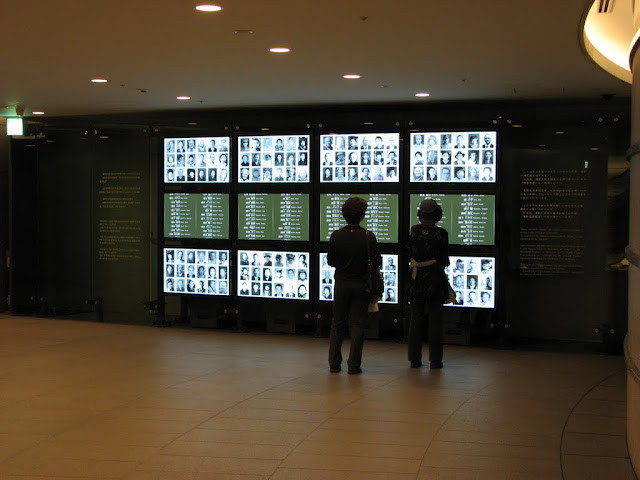
The Hall of Remembrance in Hiroshima’s Peace Memorial Park (広島平和記念公園). The wall shows the names and pictures of the dead. Nearby, you can search for specific people by family name.
Click to enlarge.
Showing posts with label Museums. Show all posts
Showing posts with label Museums. Show all posts
Friday, November 20, 2009
.
The Hall of Remembrance


Thursday, November 19, 2009
.
Hiroshima Peace Memorial
From the beginning of the trip: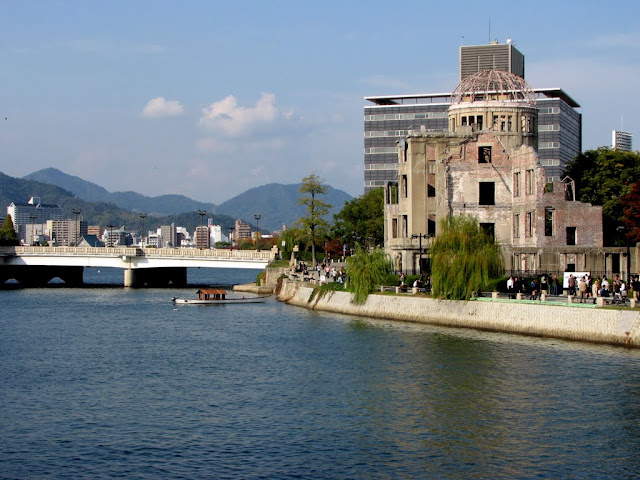
The Atomic Bomb Dome (原爆ドーム) in Hiroshima. The building, despite being very close to the center of the blast, was one of the few to partially survive the bombing.
A UNESCO World Heritage Site.
Click to enlarge.
Wednesday, November 18, 2009
.
Science museum
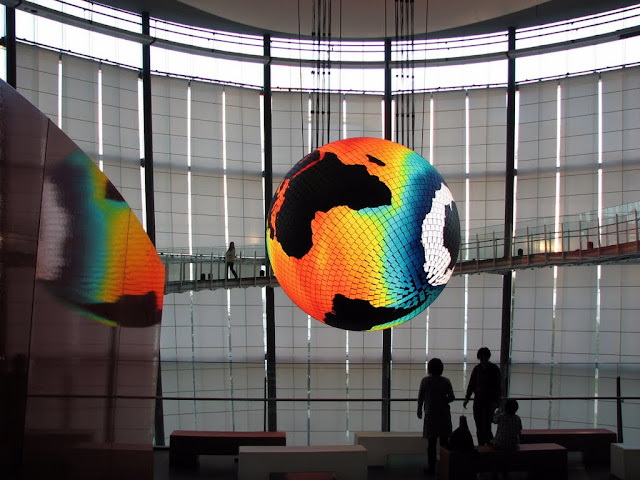
The Geo-Cosmos exhibit at the Miraikan (未来館) Tokyo’s
National Museum of Emerging Science and Innovation.
Click to enlarge.
Saturday, June 13, 2009
.
Oddly named people: Théophraste Renaudot
I ran across the name of Théophraste Renaudot a while ago, during a visit to the Newseum in Washington, DC. Monsieur Renaudot seens to have had an interesting career during the first half of the seventeenth century. According to his Wikipedia entry, he was a physician, a pawnshop owner, a historian, and a publisher.
But what got him into the Newseum is his status as the father of the newspaper: in 1631, he established La Gazette, the first weekly printed newspaper.
From 1633 to 1642, M Renaudot ran public conferences on topics of interest, and published proceedings. In her book Making Science Social, Kathleen Wellman gives us a sense of those conferences, and of the popular scientific culture of the time. From the blurb from the book:
Between 1633 and 1642, the French physician and philanthropist Théophraste Renaudot sponsored a series of public conferences in Paris. These conferences offered an open forum for wide-ranging discussions of a variety of topics, including science, medicine, gender, politics, and ethics. No matter the topic, participants consistently used scientific reasoning as a new standard of evidence. The conferences thus recast the rhetorical traditions of the Renaissance and prefigured the social sciences of the Enlightenment. They provide a candid snapshot of intellectual life at the dawn of the scientific revolution in France.
Interesting man, Théophraste Renaudot.
[And speaking of the Newseum, my favourite item at the Newseum web site is their Front Pages page.]
Wednesday, September 03, 2008
.
Storm King Art Center
 Some 45 minutes from where I live is the Storm King Art Center, a 500-acre outdoor sculpture museum. I went there with some friends on Saturday.
In contrast to the Grounds for Sculpture in New Jersey, which shows mostly smaller pieces, much of the art at Storm King is massive, really taking advantage of the expansive fields and the open sky.
Here’s a link to a satellite view of the park. Pan down, south, to the edge of the treeline, to see Storm King Wall, by Andy Goldsworthy, as it snakes through the trees. Zoom in and pan around the park, and you can see many of the huge sculptures, large enough to be visible in the satellite images.
I’ve posted some photos of my favourites to my Picasa album, and I’ve carefully geo-tagged them to get you right to the spot where the sculpture is (rather than to the spot I was standing when I took the photo).
If you’re in the area, the Storm King Art Center is definitely worth a visit.
Wednesday, October 31, 2007
.
Museum, museum
On Saturday, on a visit to the Berkshires in western Massachusetts, I stopped at two art museums there, for a couple of hours each:
- Sterling and Francine Clark Art Institute (The Clark), in Williamstown
- Massachusetts Museum of Contemporary Art (MASS MoCA), in North Adams
The Clark was a delight! From the design of the buildings to the artwork inside, I enjoyed it completely. The new building housed two special exhibitions: one of Gainsborough, Constable, and Turner, and one of eighteenth-century French painter Jean-Honoré Fragonard. In the original building is the permanent collection, including a good collection of impressionist and post-impressionist art — my favourite era — as well as important American artists such as Winslow Homer, Mary Cassatt, John Singer Sargent, and, Frederic Remington.
MASS MoCA was significantly less delightful. I’m a big fan of some types of modern art, but not the industrial sort of stuff that’s on display there, I’m afraid. You might remember my comments on the Dia Beacon museum from two months ago. MASS MoCA is rather similar, with “art” made from broken slabs of concrete, and from stacked-up box fans, with “art” presented as a video of the artist telling you that he hates his mother. There were some things of interest there — Spencer Finch’s What Time Is It on the Sun? is interesting, for instance — but overall, I was very disappointed, having wanted to visit this museum for quite some time. I’d expected it to be less like Dia Beacon, and more like MoMA (maybe because of the name, MoCA/MoMA). So, yes, very disappointed.
Of course, how could I not have checked out the web sites ahead of time, and known what to expect? D’oh!
Wednesday, March 21, 2007
.
Hands-on museums
I recently mentioned the Miami Museum of Science and Planetarium, in Florida. Apart from the planetarium, I remember loving the museum in general. I loved it especially because it had a lot of hands-on exhibits.
This will not be a revelation to anyone: Kids love to play with things. And when I was a kid, the Miami Museum of Science had many places where you could push buttons, turn cranks, shift levers, and so on. Things moved, things make sounds... and the whole place came alive for me, or so it felt, from the large dinosaur skeleton in the entrance lobby to the back corners of the museum.
In contrast, the National Musum of Natural History, in Washington, DC, for example, is full of exhibits to look at, but not to play with. Art museums may be aimed more at adults, but science and natural history museums are for kids, and they're best when they're playgrounds for learning. Instead of showing diagrams or static models of volcanos, set them up so the kids can take apart the layers, so they can press buttons and have them “erupt” loudly, so they can pretend to be the explorers from Jules Verne's Journey to the Center of the Earth (and that can prompt them to read the story when they get home).
I'm sure the Miami museum has changed a lot in the last 35 years, and I don't know to what extent it's still a hands-on place. But from the web site it looks like there's still quite a bit of that there. I think the next time I'm down that way, I'll check it out.
Friday, March 02, 2007
.
The planetarium
When I was young, I was fascinated by astronomy. I still am, actually, but not to the edge of obsession, as I was then. There were seven astronauts in the early 1960s, and I knew all their names and information about them. I'd watch all the rocket launches on TV. I wanted to be an astronaut when I grew up. I learned about the solar system and the universe. I knew the solar system's 31 moons by name, and I knew details about many of them (ha! now we've named more than 31 moons around Saturn alone, but back then there were 9). I knew the 88 recognized constellations, knew about many of the stars, could point all over the sky on a dark night and tell you many things.
I learned a lot of what I knew from books, but I also learned a lot from visits to the planetarium. When we lived in New York, my father often took me to the Hayden Planetarium at the American Museum of Natural History. After we moved to Florida, we frequented the Miami Museum of Science and Planetarium. I loved those places! I'd walk into the dome with a sense of awe, and study the Zeiss projector that would soon show me more stars than I could ever see in the real sky. The guy who was about to give the lecture would come over and tell me about the machine. I'd take my seat next to my father, the lights would go down, and we'd see the program of the day. The lecturer would tell us about the stars, about the nebulae, about the universe, all the while pointing with his arrow-light pointer (in the days before laser pointers). After the program was done, I'd go over and ask questions, soaking in everything I could about it all.
I hadn't been to the Hayden Planetarium since we left New York in 1963, until it was reopened after the construction of the Rose Center several years ago. I was eager to check out the new place and, as an adult, put myself back to my youth for a while, again enjoying the “Space Show”, the planetarium's primary offering. I went to it about five years ago, I think.
And I was disappointed.
They put on a very fancy show, make no mistake about that. It's smooth. It's glitzy. It has a celebrity narrator (Tom Hanks, when I was there; I see on their web site that it's Robert Redford now). It has special effects and videos and...
...and it's homogenized. They bring you into an anteroom, where you stand while they show you a film, narrated by the celebrity. When that's over, the doors to the dome open and you're ushered in by, when I was there, school kids, and shown to a seat. There is no Zeiss projector to be seen, no operator/lecturer. When everyone's seated, the lights go down, the celebrity narration starts, and the projector rises out of the floor. The narration is good, but the show is packaged, like Planetarium Helper®. At the end, the projector recedes into the floor again, the lights come up, and the kids usher you out. Don't try to ask them questions about anything, they're just ushers.
You can't look at the projector in awe.
You can't even walk around the dome; you're ushered in and you're ushered out.
You can't talk with the guy who's presenting the show. You can't ask any questions.
The show is the same, every time. No variation. Seen it? Don't bother going back until they change it. I don't know what the frequency of that is, and I don't see anything on the web site about when it will change.
Now, the planetarium does have other lectures and programs besides the Space Show, including a regular one-hour presentation on the last Tuesday of each month, called Celestial Highlights:
On the last Tuesday of each month, enjoy a live presentation under the brilliant stars of the Zeiss Mark IX Star Projector. This tour of the heavens offers a view of the constantly changing night sky. Learn about the current positions of the Moon, planets, and stars, as well as visual spectacles such as meteor showers, eclipses, and conjunctions.That might be more like what I remember from my childhood — I haven't tried it, so I don't know — but it's one hour each month. What made the planetarium magical for me has faded, replaced by a mass-market product, complete with glitter paint.
Sigh.
Subscribe to:
Posts (Atom)