This one’s about a week late, because of my travel. But here ’tis anyway...
Pointers to this fortnight’s blog carnivals:

Comments from a mutant slime-snake-monkey-person.

Barry Leiba
New York, United States
My work-related web page: http://internetmessagingtechnology.org
(Please see the note at the bottom of this page.)
.
This one’s about a week late, because of my travel. But here ’tis anyway...
Pointers to this fortnight’s blog carnivals:


.
I recently ran across this old item.[1] It was published in the New York Times Magazine section five years ago, and talks about a guy who made a business of catering bagels for offices, getting his payment through an “honor system”: he left the bagels unattended, along with a box for money. If you took a bagel, you were expected to pay a dollar for it. And most people did.
It’s interesting to read his statistics about those who didn’t. I have a few comments and speculations about it all.
Note that he found it necessary to close the payment box against those who would dip in:
After the doughnuts, Paul F. loaded two dozen money boxes, which he made himself out of plywood. A money slot is cut into the top. When he started out, he left behind an open basket for the cash, but too often the money vanished. Then he tried a coffee can with a slot in its plastic lid, which also proved too tempting. The wooden box has worked well. Each year he drops off about 7,000 boxes and loses, on average, just one to theft. This is an intriguing statistic: the same people who routinely steal more than 10 percent of his bagels almost never stoop to stealing his money box — a tribute to the nuanced social calculus of theft. From Paul F.’s perspective, an office worker who eats a bagel without paying is committing a crime; the office worker apparently doesn’t think so. This distinction probably has less to do with the admittedly small amount of money involved than with the context of the “crime.”There certainly seems to be, as most of us think of it, a difference between stealing money, stealing hard goods, and stealing abstract things such as artistic or intellectual property. There’s also a difference between small amounts and large ones. Just as more people will snitch a bagel than will steal the money, it seems likely that many who would take a single bagel wouldn’t consider grabbing a boxful.
There’s also the relationship one has with the entity one’s stealing from. Theft from a big company seems easier for us to justify than theft from a smaller company, or theft from an individual. I wonder, too, if there could be a diversity factor here. Would “Paul F.” see different statistics if he were Latino? Black? Middle eastern? East Asian? Does it matter? I think it might, overall. I certainly wouldn’t be more likely to sneak an item without paying for it, regardless of the vendor’s ethnicity — I wouldn’t do it in any case. But for, let’s say, a white male office worker who is inclined to get away with the occasional free bagel... would it matter?
The bagel man also speculates that executives, who grab freebies more often than lower-level employees, perhaps snitch them “out of a sense of entitlement.” The authors consider that maybe it’s because cheating is what they do, how they got where they are. Could either really be so? Or is it that they don’t steal purposefully? Perhaps it could be absent-mindedness in the face of a busy schedule, or simple cluelessness (“Ah, look: someone put out some bagels. Oh, hey, Susan, I’ve been looking for you. Can we talk about [....]”). Those seem more likely reasons to me. Rather than assume that someone thought he had a right to a free bagel, I’d like to think he thought they were put there for the taking, and just didn’t notice the payment box.
A lot of this reminds me of the item I talked about last year, on the power of “free”. There’s certainly something oddly compelling about the idea of free bagels, something that might push us to think — because we want to think so — that they’re out there for free. We take advantage of that aspect all the time, when we do provide free refreshments in order to draw people to meetings. When Stu Feldman was at IBM, we were talking about attendance at meetings once, and he said to me, “We can pay people six-figure incomes, and they’ll still get sucked in by free cookies.” (And now Stu is at Google, where they most certainly nudge more work out of people in exchange for free food.)
I’d like to see more formal studies on this, and I’m sure they’re out there. But there’s probably nothing as extensive and long-term as this informal one by the bagel man.
[1] I’m sorry not to have a “hat tip”, but I got there through a link to a link to a link, and then it sat in my browser tabs for a few days before I read it. So I have no idea where I came from to get there.
.
 One of my favourite square-dance callers, and one of my dearest friends from square dancing, John Sybalsky, died on Monday, Memorial Day, at the age of 56.
I first met John in the early 1990s, at what was then the National Advanced and Challenge Convention in Virginia Beach. I got to know him more when another (alas, also departed) square-dance friend suggested that I go to a dance where, as he put it, John “Check Your Right Hand at the Door” Sybalsky was calling. Over the years since then, we’d become friends, getting together for things other than square dancing. I’ve wine-hopped in Napa Valley with him twice, and talked late into the night at square-dance weekends, long after the dancing ended.
John was known as an eccentric caller, in a fun sense. Modern Western Square Dancing usually uses what we call “right-handed” formations, where the primary turns are to the right... and dancers are more used to those. But John was known for heavy use of left-handed formations, challenging those not accustomed to that, and keeping everyone alert and thinking. He would call something that might have seemed run-of-the-mill, and a dancer would avert a breakdown by alerting his square, “It’s left!” John would quietly respond, “Of course it’s left.”
The eccentricity went to his selection of music, as well. Many callers have come far from the old fiddle-and-banjo music, using disco, show tunes, current pop music, even techno and hip-hop. John did all of that and more, and actively sought funny, unusual, and just downright weird music to use. We would groan when he’d put on the “Chipmunk song”, or the Teletubbies theme, knowing that they would make us laugh while we danced, but get stuck in our brains hopelessly afterward. My favourite of his odd selections was Sue Keller’s excellent ragtime arrangement of Beethoven’s “Für Elise”, which she calls “Furry Lisa” (the tune starts about a minute into the video).
And what he’d say on the microphone....
Challenge dancers often record the sessions, to bring home and review later with groups of dancers in basements. We still call it “taping”, and the groups of dancers “tape groups”, even though most are using laptops, minidisk recorders, and other technology these days. And if a caller, on the microphone, corrects an error you’ve made, you’re said to be “on the tape.” “Bill, you should be behind Jane.” “Turn around, Karen.” “No, Roger, the other left.” That sort of thing is common.
With John, nearly everyone was on the tape at one time or another, often not because of mistakes, but for other reasons — John always had something to say. He was one of those callers who didn’t just give instructions from the stage, but became part of every square, in a way. Our interactions were recorded often — most frequently with my taking the good-natured bad end of it. John was sarcastic in just the right manner, and had a quick wit and a great sense of humour that I particularly appreciated.
Our conversations outside of dancing went from food and wine to politics (we agreed on much, but not on everything) to technology and computers to travel to... well, to any subject we could devise. On a 1997 trip to Napa Valley, he introduced me to Prager Winery and Port Works, an excellent little (very, very little) place that makes some nice stuff. I tasted a wonderful, oaky chardonnay while we were there, and brought home some of their 1991 “Royal Escort” port. We visited Prager again last June, and that was the last time I saw John. I still have a bottle of the ’91 port, and I think that now is a good time to open it and remember all the years past.
I’ll close with a tune I’m dedicating to John: I once suggested that he might try Walter Murphy’s disco adaptation of Beethoven’s 5th Symphony, “A Fifth of Beethoven”, and he checked it out. He liked it, adjusted the speed a little to match up with square-dance tempo (120 to 128 beats per minute), and used it. And I enjoyed dancing to it a number of times.
I’ll always miss the music, the dancing, the left-handed formations, the wit, the sarcasm... and the wine and the friendship. Goodbye, John.
.
On Tuesday of last week (19 May), the U.S. Senate passed a bill tightening the rules by which credit card companies can raise interest rates. The bill passed by a vote of 90 to 5, quite substantial. There are many other provisions in it related to credit cards, designed to protect consumers from nasty practices by the lenders.
The bill, as passed by the Senate, also includes (according to the NPR report) an amendment allowing people to carry concealed guns in U.S. national parks.
This is related to the item I wrote some time ago, about a law against computer piracy that included an amendment designating the oak as the national tree. It’s a miserable way to make legislation. Take a bill that no one can be seen to be voting against — in this case, a law protecting consumers against evil lenders — and stick on some pet project, often something that would get little support otherwise, but not so bad that it’s worth being “the guy who voted against the consumer” to avoid.
And, of course, the public will mostly hear about the credit card stuff, and won’t really understand that someone made a deal and rammed a law through that allows people to pack weapons into national parks.
But it doesn’t matter whether it’s a concealed-carry law or the designation of the oak as the national tree. This is a miserable way to make legislation, and it has to stop.
To be sure, we’d have to be careful in how we stop it; we certainly can’t hog-tie the legislative process by forbidding amendments to proposed legislation, and it makes sense to have multiple related things in the same bill. But the key word there is “related”. The way to stop it is to forbid (or place strict restrictions on) the inclusion of unrelated items in the same bill. Computer piracy and oak trees are clearly unrelated. As are credit-card interest rates and the carrying of guns in national parks.
Unfortunately, it probably would be hard to specify exactly how closely connected two items have to be, and drawing the line clearly would be a challenge.
Unfortunately, too, this is an all-too-common way for legislators to make deals with each other. “I’ll vote for your bill if you put my little project onto it,” is a typical way for the wrangling to go, as one legislator needs a few more votes, and another needs a home for a small thing that would never get passed on its own.
When the pet project is of no great consequence, the practice is merely silly, perhaps a minor annoyance at worst. But when it involves something as important as whether or not visitors to our national parks are allowed to carry concealed arms, the consequences are great, and decision on such an item can’t be hidden within the vote on a larger bill.
.
Last Tuesday (19 May), President Obama released a plan for fuel-efficiency standards that would require U.S. car companies to improve their fleet mileage by 10 miles per gallon, to an average of 36.5 MPG by 2016. It’s a modest change; we ought to be able to effect a much greater improvement than that.
That said, it is, of course, a fine thing — assuming that legislators follow through with it and don’t relax it later, as they’ve often done in the past. Such improvements are good for the consumer, decreasing fuel costs. But let’s not fool ourselves into thinking that it’s all good. Making cars that use less fuel also pushes up the cost of the cars, and this is likely to cost more than the $1,300 per car that the plan includes. Further, modest increases aren’t necessarily good for the environment, because they might not adequately offset collateral environmentally unfriendly changes, such as the use of different materials and different manufacturing methods.
But also keep in mind that modest changes in miles per gallon do not save us, the consumers, as much as we think they will. That’s because we don’t drive our cars based on gallons, but based on miles. What matters isn’t how far we can go on a gallon of fuel, but how much it costs us to go where we need to.
Consider my commute, up through February: I used to drive 22.5 miles to work. 45 miles a day, 225 miles a week. If my car got 26.5 MPG, that would be 8.5 gallons a week. If gasoline was $2.50/gallon, it would cost me $21.25 to get to work and back for a week.
Re-compute that with 36.5 MPG: 6.16 gallons, $15.40. I’d save $5.85 a week, or $300 a year, on my work commute. Computing the cost of driving 15,000 miles a year both ways yield’s a saving of a little less than $400 a year.
Note that the companies are saying that effecting the required increase in fleet economy would “add a few thousand dollars” to the cost of a car, according to one estimate. Let’s take “a few thousand” to mean, oh, say, $4,000. That would mean that at a gas price of $2.50/gallon (about what it is in my area right now), someone driving 15,000 miles a year would have to keep a car for at least ten years in order to break even on the cost.
How many of us keep cars for ten years? I do; I had my previous car for 13 years (248,000 miles), and my current car turns 10 this year (about 175,000 miles now). Most people, though, do not. Most people will not save money with this change, unless fuel prices increase significantly — which they certainly could do. If the added cost is only $3,000 and gas costs $3.50/gallon, the break-even point is 5.5 years. Many people will still replace their cars before they break even on this change, but a good number of us will benefit.
Note that I’m not saying that the change isn’t good — it might well be, and it’s certainly a start. What I’m saying is that it’s not as straightforward as it sounds.
.
This will be posted later, but it’s Tuesday, the 19th of May, as I write this, late afternoon, and I’m at Newark airport, awaiting my flight to Germany. I got here sehr early, because, well, late-afternoon/early-evening traffic around New York City can suck (that’s a technical term), and I prefer to hang with the hangars a while than to wind up in a traffic jam on the Garden State Parkway, with my blood pressure at 175/110, wondering whether I’ll make my flight.
Happily, just down the concourse from my gate is a nice an acceptable bar that serves acceptable quite nice Brooklyn beer. They have a few varieties on tap, but I favour the Hefeweizen, which is what I’ll be drinking after the dancing over the next several days. One can’t go into that sort of thing cold and unpractised, though, so I have to get my legs on, as it were.
“Hefeweizen”, for those who aren’t into beer, is an unfiltered wheat beer that’s popular in Germany, and increasingly popular in the U.S. as well. Its name comes from the German words Hefe (yeast) and Weizen wheat, and it’s also sometimes called Weisse (white), though it’s yellow (gelb) in colour, not white. We can readily get Paulaner, Franziskaner, and Weihenstephaner brands here in the states, and there’s an increasing number of American brewers making it too, including Samuel Adams... and the Brooklyn Brewery.
 And the thing is, in Germany it’s served in a particular style of glass. The Weizenglas has a very solid, heavy base, and then tapers above that to form a sort of low “waist” before it widens again with a curve, ending in a flared or bowl-like top. It’s sort of like a tall hourglass with a bit of a bowl stuck on (see right). Very elegant, really, a nice glass to drink beer from.
But the Germans are quite particular about their beer glasses, and Hefeweizen is served only in those glasses — and only Hefeweizen is served in them.  There are other glasses for Pils (see left), for Altbier, for Kölsch, and so on.
Alas, at the bar in the concourse at Newark airport they are not so particular, and so I am presented with beer heresy: the affable and helpful bartender, who says “Hefeweizen” with practiced confidence, nevertheless serves it to me in a Guinness glass. This despite that they do, indeed have Weizengläser here; I know this because a woman near me is drinking her brown ale from one (Aiiiiieeeeeeeeeeeeeeeeeee!).
In any case, it’s kind of fun to be at the airport: there are so many happy people here. People are going on vacation and are happily anticipating their fun. People are returning home and, nice though their trips were, are looking forward to being back. There are two women and a man over there, looking at a tourist guidebook to Spain. And over on this side are two German men, perhaps going home, perhaps on the same flight I’m on. One of them has a booklet for the North Sea Jazz Festival, which seems to go well with the upbeat Billie Holiday song playing on the music system right now.
There’s a family in the corner, Mom and Dad having beer, and the kids in obvious delight over wherever it is they’re about to embark for.
And as I look out the window, there’s a Continental jet called the “Robert F. Six” (who knew they had names?) looming large in front of me, having food and baggage loaded into it. And there’s the Empire State Building and the rest of the New York City skyline in the distance.
.
I’m off for my annual pilgrimage to Fürstenhagen, Germany to do C3B-level square dancing.
I don’t expect to have much (or any) blogging posted between now and when I return. Check back here next Monday evening or Tuesday, and I’ll be back to writing in these pages then.
.
This is one of the best songs ever written, and Eric Clapton gives us two versions. Since I love the song so much, and since it’s been on my mind lately, here they are, from YouTube (and I’ll use the embedded versions, rather than my more customary links).
.
Some UCSB researchers managed to infiltrate the command-and-control system of a botnet, and got lots of information out of it, which they wrote up in a paper.
Their results are interesting to read. But, really, I’m not at all surprised that lots of people continue to get their computers infected, that so many use bad passwords, or that so many use the same password on many web sites. It’s always nice to get specific data on all that, but it’s something we’re well aware of.
What I find especially troubling is this part:
Interestingly, a large number of the financial institutions that had been breached required “monumental effort” in order to notify the victims, according to the report. In fact, financial institutions weren’t the only ones—interacting with registrars, hosting facilities, and law enforcement were all “rather complicated,” indicating that there’s a long way to go in order to make notifying botnet victims easier.Unfortunately, the reporter got the “monumental” sense completely wrong; they did not say that a large number of the institutions required monumental effort, but that “the large number of institutions that had been breached made notifying all of the interested parties a monumental effort.” That’s not the same thing.
Still, there’s a problem, so let’s say that again, taking it from the paper itself:
Another insight obtained from the experience of taking over the botnet was that interacting with registrars, hosting facilities, victim institutions, and law enforcement is a rather complicated process. In some cases, simply identifying the point of contact for one of the registrars involved required several days of frustrating attempts. We are sure that we have not been the first to experience this type of confusion and lack of coordination among the many pieces of the botnet puzzle.They suggest that U.S. law could make this significantly better by imposing “simple rules of behavior,” not on the criminals, but on the entities that one has to involve in reining the criminals in.
I’m skeptical of that. Perhaps it’s true in theory, but experience shows that laws help little in this area, and, in fact, a poorly crafted law can actually make things worse, when parties are forced to adhere to the letter, rather than to the spirit.
What would work better, at least on the U.S. side, is the designation of an organization responsible for sorting through the pieces — I suggest the Federal Trade Commission, which is already responsible for dealing with many aspects of the spam problem. I’m not surprised that the researchers had trouble getting through all of this: the organizations involved each had to confirm, to their own satisfaction, that the story they were being given was true, and that they weren’t dealing with yet another set of “bad guys” who were trying to hack the system. And in cases where legal devices (such as search warrants) might be needed, the researchers were likely unfamiliar with the law, and not used to dealing with those requirements. A department in the FTC would be properly equipped to pursue this sort of thing much more efficiently and effectively.
.
I’ve long thought of the Cub Scouts and Boy Scouts, together officially called the “Boy Scouts of America”, as a paramilitary organization. I’ve actually thought that ever since I was a child of nine, when I tried out the Cub Scouts briefly. I think my tenure survived a field trip to Miami’s Museum of Science and Natural History — and then-new Space Transit Planetarium, my favourite part (the museum is now called the Miami Science Museum). I probably joined mostly because I thought they’d be doing a lot of that sort of thing. But then I found that I had to get “merit badges” for doing useful stuff like learning to identify cars as they drive by, and such. And there was all the bother about special salutes and reciting a pledge to serve “God and my country.” So I bailed out tout de suite.
My opinion was only reinforced when I learned that, in fact, the organization will expel atheists, and then even more when they announced their own “don’t ask, don’t tell” policy, barring gay scouts and adult scout leaders. They’re allowed to do all this because they’re officially a “private” organization.
Of course, they suck boys in with the promise of camping trips and such (and, as some of their web pages cite, “cool uniforms!”). But underneath, it’s sort of “military school lite”.
Only, it’s not always “lite”, not always paramilitary. The New York Times points this out in an article about their anti-terrorism training, where gun-toting 14-year-old “Explorers” learn, not to explore, but about hunting down illegal immigrants and “taking out ‘active shooters’.” I’d say that boys and girls of 14 to 16 should not be learning to “take out” anyone, except in the context of dating.
Ten minutes into arrant mayhem in this town near the Mexican border, and the gunman, a disgruntled Iraq war veteran, has already taken out two people, one slumped in his desk, the other covered in blood on the floor.A step up? Hardly!The responding officers — eight teenage boys and girls, the youngest 14 — face tripwire, a thin cloud of poisonous gas and loud shots — BAM! BAM! — fired from behind a flimsy wall. They move quickly, pellet guns drawn and masks affixed.
“United States Border Patrol! Put your hands up!” screams one in a voice cracking with adolescent determination as the suspect is subdued.
It is all quite a step up from the square knot.
One of the Border Patrol agents who acts as a mentor notes, “Our end goal is to create more agents.” Training to be a Border Patrol agent at 14? That seems a bit much to me. And then there’s this:
In a competition in Arizona that he did not oversee, Deputy Lowenthal said, one role-player wore traditional Arab dress. “If we’re looking at 9/11 and what a Middle Eastern terrorist would be like,” he said, “then maybe your role-player would look like that. I don’t know, would you call that politically incorrect?”Um. Yes. But let’s not pooh-pooh the issue by calling it “politically incorrect”; when you put an image like that in front of children, you’re teaching them to equate Arab dress with terrorists. Too many adults can’t separate the thoughts; how can we expect kids to do it?
So I no longer think of the Boy Scouts as paramilitary. It’s full-on early military training, with a thin veneer of “fun for the kids.”
Oh, and then we have this:
There have been numerous cases over the last three decades in which police officers supervising Explorers have been charged, in civil and criminal cases, with sexually abusing them.Hey, at least we know they’re straight, and they believe in God.
.
In this week’s “The Ethicist” column, Randy Cohen comments on people who admit to driving without a license — to their bankers. A bank teller from Wisconsin asks this:
I am a bank teller. When I work the drive-through window, every week or two customers present a state ID instead of a driver’s license, often acknowledging that they have no license. As a teller, I must keep bank information confidential. As a citizen, I worry about the dangers of unlicensed drivers. May I report them to the police?Mr Cohen’s response is that it is not ethical to report them. I’m not sure that I agree, because I don’t look at it as a situation where the customer expects confidentiality in that regard — this isn’t part of the financial information that the customer very rightly demands confidentiality on. Mr Cohen does allow an exception for “serious imminent danger”, but doesn’t think this qualifies, that driving without a license “does not in itself constitute a sufficient threat to warrant [...] calling the cops.” I disagree with that, too. An unlicensed driver likely lacks a license for a reason. Perhaps the driver can’t pass the test; that would certainly present a danger to others. Perhaps the license has been revoked because the driver has consistently presented a serious danger indeed.
In any case, Mr Cohen adds this:
It is impressive that unlicensed drivers regularly use the drive-through and cheerfully acknowledge law-breaking rather than simply park and do their banking indoors — a stirring example of either sheer bravado, stunning dimwittedness or a robust determination to avoid exercise, even by walking from the parking lot to the bank.That was part of my reaction, too, on reading the question. One generally confesses to one’s bartender, or hairdresser, but not, as a rule, to one’s bank teller. This seems odd. And, yet, a refusal to park and walk, even when the walk is quite short, is something I see all the time — and it always amazes and amuses me.
I regularly see people leaving their cars in the fire lane to stop in at the deli or pizza shop, at the post office, at the dry cleaner’s, and... yes... at the bank. And all this when there are legal parking spots just a few steps away. At one place where I occasionally use the money machine, I’ve been ten steps (I counted) farther from the machine than the person who stopped illegally at the curb.
Perhaps my favourite incident was the time I went to the library and watched a woman park in a space reserved for handicapped drivers. I was right behind her, and parked three spaces away — farther by the width of three cars, and there were plenty of other parking spaces nearby. When I got inside, I saw her looking at books near the entrance, and I asked her if she was aware that she’d parked in a handicap space. She replied that she was only going to be a minute. “Yes,” I said, “and that might be just the minute that a disabled person should arrive and need that space.”
She said nothing in response, but I did my business and left before she did. “A minute” is seldom really so.
.
There seems no more depressing subject, and yet it’s a discussion that has to happen, an investigation that has to be done. The U.S. Senate Judiciary Committee is dipping its toes into those waters this week, as a subcommittee convenes hearings on the recently declassified memos:
On Wednesday, a Senate Judiciary subcommittee will hold its first hearing into torture since the Obama administration declassified memos authorizing harsh interrogations.In the weeks since those memos became public, researchers have compared the documents with testimony from previous hearings on torture. They have looked for contradictions between what government officials claimed when the program was classified and what we know now that the program is public. The project’s leader, Karen Greenberg, has concluded that “we’ve been spun every which way.”
The hearings are being held by the subcommittee on Administrative Oversight and the Courts (not, I should note, by the subcommittee on Terrorism and Homeland Security), chaired by Sheldon Whitehouse (D-RI). Senator Whitehouse started right off by accusing the Bush administration, saying that “senior Bush officials had repeatedly lied about the interrogation program in ‘an avalanche of falsehood.’ ”
There’s really little doubt about that, though those supporting the “harsh interrogations”[1] wouldn’t call them “lies”, and consider it all justified on the basis of its significance to national security:
[Senator Lindsey Graham (R-SC)] suggested that techniques like waterboarding, which President Obama and others in his administration have condemned as torture, had produced valuable intelligence that protected American lives.“One of the reasons these techniques have been used for about 500 years is that they work,” Mr. Graham said.
Now, whether “they work” or not is a matter of some debate. It’s clear that any interrogation will get a mixture of useful and useless information, and the question there is whether torture increases the proportion of the useful stuff, and whether the interrogators are able to distinguish the one from the other in any useful way. And in this debate, those most insistent that it works are the administration officials and those supporting them from the outside. Most former interrogators sit on the other side — they say it doesn’t work.
But whether torture works or not is somewhat beside the point. The real key here is that we don’t do these things. It’s not the “American way.” The bad guys torture prisoners for information; we’re better than that.
Or, we used to be.
To say that we should eschew torture because it’s ineffective implies that we should torture with relish if we know it works. It’s like saying that the reason not to cheat or steal is that you might get caught. We certainly hope that the threat of being caught is a deterrent, yes. But we teach our children not to cheat and not to steal... because it’s wrong to do these things. It’s not our way. And we don’t change that by considering whom we might steal from: it’s wrong to steal from thieves, just as it’s wrong to steal from the nice family next door.
To live in a civilized society, we have to hold to certain ethical behaviour. Torture is unethical and immoral, whether it “works” or not.
Lying to Congress and abusing executive power are also wrong, also unethical... and are illegal, as well. As the Senate looks at the evidence, they’ll see criminal acts, which should be prosecuted. And they’ll see that the administration, at every level, supported a program of torture.
The Bush administration put us in a War on Terror. They ordered the torture of suspected terrorists. Torture is a war crime.
That part is simple. Now, what are we going to do about it?
[1] Is that a great euphemism, or what?
.
My former colleague Bob Sutor is IBM’s Vice President of Open Source and Linux. In the linked blog post, Bob suggests pushing Linux instead of Windows 7:
I think members of the Linux community need to respond if they believe that the Linux desktop is a better choice and more suitable to be on machines given to friends and loved ones. This doesn’t mean waiting until December 1, it means thinking about how to 1) promote Linux desktop and its tools and applications, and 2) preparing to counter Microsoft claims as it gears up to claim that Windows 7 is the best operating system since WindowsFor starting ideas, Bob suggests these angles:VistaXP.
Top ten reasons to give Mom a Linux desktop for the holidays?How to get two or three more years from Dad’s computer while giving him the gift he really wants?
Linux: the operating system that gives you more and saves you money?
Let’s step back a moment, and look at some of the reasons that most people use Windows:
Now, why might you want to avoid Windows?:
OK, so.... Many manufacturers will give you the choice of Windows or Linux. Windows will come by default, but if you ask, you can often get Linux, and it might even take a few dollars off the price, because it avoids the Windows license fees.
If you think of Microsoft as a large, inflexible monolith, you should probably tar Apple with the same brush. Apple has an image of being more “cool” than Microsoft, but, if anything, its interfaces to its hardware and software are more tightly closed than Microsoft’s are. Linux, of course, is pretty much wide open. Though people can certainly provide (for free or for sale) closed pieces, it’s not the Linux culture.
 Take it from a Windows user who’s had a Mac for two years: MacOS isn’t easier to use than Windows. It’s just different — not better, not worse, just different.[1] It probably was true that Macs were easier, back in the days of Windows version 3 and Windows NT. But Windows 95 changed all that, and with each subsequent version it’s been getting smoother.[2] Linux desktop managers — one can choose among several, though the distribution installed on your computer will likely be set up with one in particular — are also easy to use (and, yet, different still), so this is really not a big issue. The point here is that if one is starting out, one will learn whichever desktop environment one is given... and if one is already used to one, changing to any other will be disruptive for a while, but one will get used to it.
That leaves the various software issues. So let’s spend a few minutes on those.
The software one needs depends largely on what one does with one’s computer. I, as a programmer, use various software development tools that my mother, for example, won’t need. Some people use things like Illustrator, Photoshop, Dreamweaver, and Flash. Some use various video editors. Gamers have their own needs.
But if we’re just looking at what most people need — people who use their computers for email and web access, and the occasional spreadsheet — we’re looking at a more limited set of software. A few years ago, we’d have listed the necessary stuff as an email program, address book, calendar, web browser, and an office suite (word processor, spreadsheet, presentation maker).
If anything, though, we’re paring that list down. Many are using web-mail services, such as Gmail. They usually include address books, and may have calendars too. For the office suite, there’s always OpenOffice, an open-source program, to take the place of Microsoft Office. But one can even avoid that by opting for an online service like Google Docs.
Indeed, you can set yourself up as an all-Google house if you like. Gmail handles mail and address book. Google Calendar and Google Docs will do the other stuff. You can use Google’s Picasa for your photo editing and storage. And most of us don’t need more than that. Skype, maybe, and that runs everywhere — and there’s even Google Voice, their re-branding of the recently acquired GrandCentral, which is adding Skype-like functions.
Of course, we’re exchanging one monolith for another, by doing that, and we’re moving our information — email, contacts, schedule, documents — onto Internet servers out of our direct control. We might think about whether we really want that.
In other words, many people will need nothing more than a web browser, which is certainly no problem for any operating system. If you use Firefox, all the plugins you need will run on Windows and MacOS and Linux. Opera runs on those, too, and on Solaris too... and there’s even an OS/2 version, in case anyone’s still using that.
So, the vast majority of people will not have to worry about software. The key to enabling Mom and Dad to use Linux instead of Windows is
That fourth one might just be the hardest part.
[1] See my posts about my experiences with my Macbook, in which I point out a number of aspects where MacOS is different, and sometimes internally inconsistent.
[2] I did stop at XP, though, so I can’t speak for Vista. I’ve heard mixed reviews of Vista: some love it, and some think the changes have made it worse.
.
Recently, I was discussing the relative virtues of four-door and two-door cars with a friend. I prefer four-door cars, because they make it much easier for back-seat passengers to get in and out (they make it easier to access the back seat, in general). My friend prefers two-door cars, because he seldom has back-seat passengers, and the larger doors of two-door cars make it easier for the front-seat occupants to get in and out.
“But,” I say, “on a two-door car, the doors are larger and heavier. Also, if you’re in a limited space, the doors can’t open as far, and the smaller opening actually makes it harder for the people in the front seat.”
I also recently read Kate Nowak’s post “Introducing Right Triangle Trig”, from her blog f(t) [Function of Time].[1]
Putting the two together, I thought it would be fun[2] to turn the car-door discussion into a trig problem.
Suppose I park my car in a garage. The side of the car is some fixed distance from the garage wall, limiting the amount that the door can open. Figure 1 illustrates that: the car is parked at a distance of a from the wall (because mathematicians like to confuse things by representing everything with incomprehensible letters), the door has a length of d, and when the edge of the door hits the wall, the angle the door makes with the car is t. (Click on the figures to enlarge them.)
Figure 1
What we want to know is how big the opening (o, in figure 1) is, so we know how easy it will be for a person to get in when the door is as far open as it can be. Noting that the closed-door position, the open door, and the opening form a triangle, we bet we can sort this out with trigonometry.
The first step is to drop a line from the tip of the door to the car, perpendicular to the car. The dashed line labelled a in figure 2 forms a right triangle.
With respect to angle t, the opposite side has length a and the hypotenuse has length d. The sine of the angle, sin(t), is the opposite side divided by the hypotenuse, or a/d. So we have our first formula, which we can solve for t:Figure 2
sin(t) = a / dt = arcsin(a / d)
Now we’ll note that the two sides of length d form an isosceles triangle with base o. That means that if we bisect angle t we’ll get two equivalent right triangles (figure 3).
We now have an angle t/2, a hypotenuse d, and an opposite side o/2, giving us our second formula, which we can solve for o:Figure 3
sin(t / 2) = (o / 2) / do = 2 * d * sin(t / 2)
It’s time to plug in the numbers.
Let’s assume that a four-door car’s front door is 4 feet long, and a two-door car’s door is 6 feet long. And let’s say we park the car 3 feet from the wall. So, for a 4-door car:
a = 36 in, d = 48 inAnd for a 2-door car:sin(t) = 36 in / 48 in
t = arcsin(36 / 48) = arcsin(.75) = 48.59 degrees
sin(48.59 / 2) = (o / 2) / 48 in
o = 2 * 48 in * sin(24.295) = 2 * 48 in * .41143 = 39.5 in
a = 36 in, d = 72 insin(t) = 36 in / 72 in
t = arcsin(36 / 72) = arcsin(.5) = 30.00 degrees
sin(30 / 2) = (o / 2) / 72 in
o = 2 * 72 in * sin(15) = 2 * 72 in * .25882 = 37.27 in
So, though the door on the two-door car is longer, with the wall restricting it the door will create an opening that’s about two and a quarter inches (5.6%) smaller. That’s actually less of a difference than I’d expected. It was good to do the exercise, which showed that I was right... but not by enough to matter.
[1] I love that blog name!
[2] Demonstrating, as it does, why we mathematicians are in such demand at parties.
.
Finishing my series of comments on the New Scientist magazine series “Eight things you didn’t know about the internet”, we have question 8, “Could we shut the net down?”, by Michael Brooks.
It’s not clear to me what the question really means, and why it’s being “asked”. Mr Brooks answers it as though the real question is, “Could one party (to a first approximation of ‘one party’) unilaterally shut the Internet down?”, whether that might be done officially, maliciously, or otherwise. To that question, the answer is certainly “No.”
One interesting thing about Mr Brooks’s answer here is that it flies in the face of his answer in part 1, where he puts a lot of power in the hands of the U.S. government. But he’s correct here, not there: even the U.S. government could not shut the Internet down — though it certainly could interfere with it severely, simply because of how much Internet service and infrastructure sits in the United States. Many key sites could be shut down, including key ISPs and other services. The effects would, I believe, go well beyond the boundaries of the U.S., and would certainly have “strong effects [...] on a worldwide basis.”
Of course, should that happen, the rest of the world would quickly respond and replace those services. The disruption would be short-lived.
The difficulty of shutting things down can be demonstrated by the situation in China, where a number of attempts have been made to block access within China, as I noted the other day, to various services from outside that the government considers unsuitable for their citizens. But the fact is that Chinese Internet users have been able to get around those restrictions, by using satellite services, by taking advantage of proxy servers, and through other techniques. A country could certainly shut down service within its borders, and could make it a criminal action to bypass the restrictions... but the restrictions would be bypassed nevertheless.
Indeed, attempts to shut down various specific activities on the Internet have also failed. For better or worse, gambling, cyber-stalking, child pornography, misuse of copyrighted material, theft, scams, and everything else you can imagine continue on the Internet, despite efforts to stop them — just as is the case in the non-cyber world. Caveat user.
But another spin on the question goes more toward the old science-fiction scenarios. What if computers became too powerful? What if the Internet became a threat to people, and we collectively decided to shut it down to protect the human race. Not one party, unilaterally, but a general agreement... say, a significant majority vote in the U.N., with unanimous consent of the Security Council. Could we shut it down then?
I think the answer to that is also “No.” Not for the science-fiction reason that the computers themselves would prevent it (see part 2, “Could the net become self-aware?”), but for the more mundane, straightforward reason that contrary elements within our population would keep it going. The technology to run the Internet is out there, and it’s readily and inexpensively available. It’s not the “rocket science” that it once was.
The apple has been eaten.
.
Part 7 of my series of comments on the New Scientist magazine series “Eight things you didn’t know about the internet” goes into the “carbon footprint” of the Internet: “Is the net hurting the environment?”, by Duncan Graham-Rowe.
It’s easy to think that the Internet can only be helpful to the environment. If you’re shopping online, you’re not driving to the store in your car. If you’re reading things online, you’re not printing the material, using paper and having trees cut down for it.
But all those servers, routers, and communication gateways take electricity to keep them running, and that means burning a lot of coal and splitting a lot of atoms.
Sending an email across the Atlantic Ocean does not burn any jet fuel, but the internet is not without its own, huge carbon footprint. One estimate suggests it takes a whopping 152 billion kilowatt-hours per year just to power the data centres that keep the net running. Add to that the energy used by all the computers and peripherals linked to it and the whole thing could be responsible for as much as 2 per cent of all human-made CO2 emissions, putting it on a par with the aviation industry.
At the technical plenary session in Vancouver in December 2007, the IETF looked at this issue (PDF), with guest speaker Bruce Nordman of the Lawrence Berkeley Lab — Mr Graham-Rowe quotes Dr Nordman’s LBL colleague, Jonathan Koomey.
Researchers in energy-efficient computers and networks are looking at ways to use less power in the first place, as well as at ways to power down components when they’re idle. Some approaches to the former are obvious: exchanging travel for electronic conferencing, developing devices that can do their jobs with less power, and so on. On the other hand, we’re countering those aspects with ever-faster processors and ever-larger hard drives, which take more power to run.
The challenge for powering down components is in accurately detecting — or anticipating — the need to use a component, and getting it powered-up and ready quickly. If we get it right, the benefit can be huge: a lightly used server may be spinning a hard drive 24 x 7, when it might be able to shut the drive down 50%, 60%, or even 80% of the time, if it can get it running quickly again. Perhaps a web server might have low-power flash memory that could hold the site’s home page, a few other key pages, recently accessed pages, and first-level links from those. Most of the time, it could serve requests from the flash memory and spin the disk up to prepare it for the next request, for which it’s more likely to need the disk.
With similar sorts of adjustments and increasingly sophisticated algorithms, we can reduce the power consumption of the different computer and network components, and really get the Internet to save natural resources.
.
The Ridger has a post about when song lyrics aren’t considered as a whole. She considers the use in an ad of the song “Major Tom”, by Shiny Toy Guns, a reworking of the story from David Bowie’s song “Space Oddity”. They’re using it to hawk a car, to make the car seem space-age. “Loaded for liftoff,” is one tag line in the ad. “Reach higher,” is another.
Only, as The Ridger notes, in the song, Major Tom lifts off... but doesn’t return:
Sure, if you don’t know the song, it sounds cool[...]YouTube has the advertisement, and the full song. Lincoln has another ad that uses “Space Oddity”, as covered by Cat Power; on YouTube here.But if you know the song, do you want to buy that car? Major Tom dies!!!
The question is this: Does it matter? Will anyone really notice, apart from a few of us who wouldn’t buy the car anyway?
Most people don’t have a clue about most of the lyrics in most of the songs they hear. Yes, a few of us really absorb them, internalize them, treat them as poetry. But for most people, “Space Oddity” consists of “Ground control to Major Tom,” something about “planet Earth”, and a bunch of music. “La-la-la-la-tin-can, dum-dum-dum....”
That’s especially true if the song has a catchy tune: the tune takes over, and people remember few of the lyrics, apart from one or two lines in the refrain.
Take “The Gambler”, written by Don Schlitz and on the pop charts by Kenny Rogers in 1979. Everyone knows the song, right? Everyone knows the chorus, about knowing when to hold ’em and knowing when to fold ’em. Does everyone know what happens? The gambler dies in his sleep on the train. But most people never listened to it closely enough to get that.
Speaking of Kenny Rogers: he had a big hit in ’69 with the Mel Tillis song “Ruby, Don’t Take Your Love to Town”. It’s got a good, bouncy rhythm, very cheerful. But listen to the words: the singer is a paralyzed war veteran (Korea, but when the song was written it could as well have been Vietnam), Ruby is going out cheating on him, and he’s begging her not to. “Oh, Ruby, for God’s sake, turn around.” It’s a serious song, about a difficult subject... but how many people don’t think about that, because the title is all they know and the tune is up-beat?
I’ll throw one more out there, from one of my favourite poet-songwriters, Leonard Cohen. “Hallelujah” easily sounds like a nice, spiritual song, and many folks take it as such. But as with most of Cohen’s work, there’s a lot of metaphor, there are several layers of meaning, and nothing’s straightforward. Listen to the words next time. It’s not a gospel song.
Those of us who really listen to lyrics can cluck about the inappropriateness of a particular song, sure. But the mood is set for most people, and it works.
.
This time, a new carnival comes to my list. The Carnival of Mathematics is unreliable these days, coming and going from time to time. I’ll continue including it if/when it does appear. But Math Teachers at Play, which started at Let’s Play Math! in February, will show up here regularly now. Enjoy.
Pointers to this fortnight’s blog carnivals:
Update, 11 May: I’ve just found out that a Carnival of Mathematics has been posted this fortnight, after all. So:
.
For the next installment in my series of comments on the New Scientist magazine series “Eight things you didn’t know about the internet”, we have two for one. Actually, not really: I’m going to skip part 5, “Is the net caught in the credit crunch?”, because I have nothing to say about it, and move right on to part 6, “Where are the net’s dark corners?”, by Ben Crystall. Here, we get into the discussions of malware and other Internet crime.
There are plenty of places online that you would do well to steer clear of. A brief visit to some unsavoury websites, for instance, could leave your computer infected with worms or viruses. Then there are the “black holes” to worry about.
On the malware side, I’ve said quite a bit already about web sites and email that try to infect your computer. The malware that’s gotten the most press recently, though so far its effects have been benign, is Conficker.
Network “black holes” shouldn’t be of direct concern to you, for the most part. Visiting a particular web site might cause your browser to appear dead, but it won’t affect your online experience beyond that: you can just go to another, legitimate web site and it will work fine. It’s possible, though, for an attacker to get a black-hole site into the Domain Name System or into routing tables, causing more extensive difficulty.
You’re more vulnerable to this sort of thing if you allow your computer (or iPhone) to connect to arbitrary wireless networks, which might themselves be black holes, or which might be attacked using black-hole techniques.
Then there’s the side of the Internet that tries to hide from you: the part that supports illegal activities. There are sub-networks for those engaged in buying and selling stolen credit-card numbers, leasing time on botnets, and the like. Rob Thomas gives an excellent presentation on this, and the corresponding paper, The Underground Economy: Priceless (PDF), is a good read.
For more about Internet crime and online security, let me point to two books:
.
On to part 4 in my series of comments on the New Scientist magazine series “Eight things you didn’t know about the internet”: “Is there only one internet?”, by Ben Crystall.
As with all the questions so far in this series, this one brings up a series of subordinate questions, the answers to which are not simple. The most basic of these is how one defines “the Internet”, and how one decides its boundaries. Mr Crystall starts with this:
Probably — for now. The internet is a disparate mix of interconnected computers, many of them on large networks run by universities, businesses and so on. What unites this network of networks are the communication languages known as the Transmission Control Protocol and the Internet Protocol, collectively TCP/IP.He goes on to suggest that human-language issues, dealing with Russian and Chinese character sets, could fracture the Internet.
It’s hard to say what will actually happen in that regard. The IETF has been working diligently on internationalized domain names and email address internationalization, to try to stave off such fragmentation. Indeed, the mechanisms are in place, and there already are domain names registered in Russian, Chinese, Korean, Japanese, Hebrew, and other languages that use character sets that used to be incompatible with the Internet’s Domain Name System. The internationalization protocols allow such languages to be represented in ways that are compatible, but that can be displayed in the native formats... for the most part, everyone is happy.
On the other hand, even if Turkey can have domain names in Turkish, what happens when they decide to block access to YouTube? And China... even though China has more Internet users than the U.S. does, what happens when they, too, block YouTube, along with other web sites, including the New York Times? Is it still all one Internet then?
Apart from the censorship question, we clearly create parallel networks all the time. Corporate firewalls, for example, break off pieces that are otherwise physically connected. When I worked at IBM, I had access to services on the “big-I Internet”, as we called it, as well as those on the “little-i intranet”. We used the same protocols, and we were connected to the same Internet servers and services. Yet now, from outside the firewall, I can no longer get to what used to be my internal web or email servers.
Doesn’t that mean that there’s a separate Internet in IBM, and in most other large companies?
It’s likely, too, that even as a customer of a typical Internet service provider, if you try to send email directly to an email server on the Internet, you’ll be blocked. You’re expected to go through your ISP’s email infrastructure, an attempt to clamp down on zombie computer “botnets”.
The reality is that what we call “the Internet” comprises a collection of distinct networks that use common network protocols, and that more or less agree to cooperate. And, in fact, there is a parallel network called Internet2, set up for academic and research use (as was the original Internet, back in the day).
So... the answer is “Yes and no.” There’s certainly one, single “Internet” that we all think of as the place we go to for Google and Amazon, Facebook and YouTube, the New York Times, the BBC, and the Sydney Morning Herald. But, ultimately, it’s made up of countless little networks, along with the standardized “glue” that holds it all together.
.
Next in my series commenting on the New Scientist magazine series “Eight things you didn’t know about the internet” is part 3, “How big is the net?”, by Colin Barras.
That the internet is vast is undoubted. In July 2008, web surfers were introduced to Cuil.com, billed by its designers as “the world’s biggest search engine”. It indexed an impressive 120 billion pages, but shortly before its launch Google announced that its systems had registered a trillion unique pages (see Internet census 2007 and 2008).Even this might represent a fraction of what is out there. Some estimates suggest that there could be hundreds of times more information stored on the internet than Google or Cuil have so far indexed.
In the early 1990s, in earlier days of the worldwide web, the NCSA had a web page that listed all the new web sites that had recently gone up — first it was weekly, then daily — and you could actually check out everything that was new on the Internet that week, or that day. Indexing and searching the relatively small number of web sites was a fairly easy task at the time, and publishing a complete list was reasonable. If you missed checking their list for a few days, or a week, you could go back and catch up.
That soon changed, of course, and nowadays complex web crawlers compete in finding the most useful subset, it being essentially impossible to index everything any more. The web monitoring service Netcraft reckons that as of their April 2009 survey there were more than 230 million web sites, with 6 million having been added in the last month — an average of some 200,000 per day. You’d have to check about 3 sites every second, 24 hours a day, in order to look at all of the new ones now.
Even defining what a “web site” is is more complicated than it used to be, and Netcraft has its own definition and mechanism for deciding. I think we’d all agree that each blog hosted at blogspot.com is its own “site”. What about each different Facebook page? Each LinkedIn profile? How many distinct “sites” are there at ibm.com? We probably wouldn’t consider what you get if you click on Services to be a distinct site, but the alphaWorks pages might be, and the IBM Research pages probably are. How do we decide?
There’s also more to how “big” the Internet is than number of web sites, bytes of stored data, or number of Internet users. How much hardware is out there? How much electricity does it use? How many bits are shifted around from place to place? Should we look at a connectivity map? How much money is spent on Internet infrastructure? It seems rather like asking how big outer space is.
Maybe a more useful question is “How important is the Internet?” To that, I say that I can’t imagine doing any sort of business or research today without it.
.
Today I’ll continue my series commenting on the New Scientist magazine series “Eight things you didn’t know about the internet”. Part 2 is “Could the net become self-aware?”, by Michael Brooks.
Mr Brooks opens with this:
In engineering terms, it is easy to see qualitative similarities between the human brain and the internet’s complex network of nodes, as they both hold, process, recall and transmit information. “The internet behaves a fair bit like a mind,” says Ben Goertzel, chair of the Artificial General Intelligence Research Institute, an organisation inevitably based in cyberspace. “It might already have a degree of consciousness”.Of course, this whole discussion depends upon what it means for it to be self-aware, how one defines “consciousness”, and Mr Brooks looks at that in the rest of the article, considering a “network that constantly strives to become better at what it does, reorganising itself,” and such. “It could happen within a decade,” says a Belgian researcher.
Indeed, this is exactly the sort of thing that many of us are working on, in a number of ways.
The Internet standards community has been, for some years, working on standards to help in service discovery, and in automatically routing around problems in the network. Those working on search technology have been developing better search mechanisms and algorithms that are more likely to find what you’re really looking for. Natural-language experts continually come out with systems that more accurately understand things that users say in plain language.[1] People working on pervasive/ubiquitous computing are always looking at how a network of always-connected everyday devices can take advantage of the Internet to enhance our typical, mundane activities.
All of this fits together into a network that “knows what it needs to do” to serve us better. It can find information for us, locate the services we need, repair itself when there are glitches, and communicate with its components without our having to stay “in the loop.” Before long, it will anticipate what it should do and get a jump on us — in some ways, it’s already doing that. In many senses, those are things the human brain does.
Does that make it “self-aware”? I don’t think I’d call it that, but it really is a question of semantics.
[1] Though I don’t think any of this will serve the fellow who reached one of my monthly archive pages with a Google search for “please help me! i’m being hunted by a government agency that doesn’t exist.”
.
New Scientist magazine has posted an eight-part article titled “Eight things you didn’t know about the internet”. As someone who knows about the Internet, I thought I’d comment on the various parts. Today, part 1: “Who controls the internet?”, by Michael Brooks.
Mr Brooks gives his answer to the question in terms of ICANN:
The official answer is no one, but it is a half-truth that few swallow. If all nations are equal online, the US is more equal than others.Not that it is an easy issue to define. The internet is, essentially, a group of protocols by which computers communicate, and innumerable servers and cables, most of which are in private hands. However, in terms of influence, the overwhelming balance of power lies with the Internet Corporation for Assigned Names and Numbers, based in Marina Del Rey, California.
Hm.
While I’ll certainly agree that the U.S. has more than its share of influence, I’ll disagree with Mr Brooks in several respects.
First, looking at ICANN: it’s true that ICANN is incorporated as a non-profit organization under U.S. law (and that of the state of California). And it’s true that ICANN receives funding from the U.S. Department of Commerce. But ICANN does not “report to” the Department of Commerce, and there are no members of the ICANN Board of Directors who work for DoC, nor any other arm of the U.S. Government. In fact, several of the board members are staunch supporters of an open Internet that’s not under the thumb of any government, and the members hail from an assortment of countries, including New Zealand, Australia, Brazil, Chile, Norway, and India, as well as the United States.
As one (but not the only) source of funding for ICANN, the DoC does have pull, of course. But it’s misleading to say that “ICANN reports to the US government’s Department of Commerce,” and that the DoC therefore “oversees” everything.
ICANN is not involved in the routine assigning of domain names, which is handled by the registrars. ICANN accredits the registrars, and, yes, ICANN can withdraw the accreditation of a particular registrar (and has done so, for good cause). But the idea that the United States could abruptly shut down domain name registration is ludicrous.
Apart from that, ICANN controls only a small part of what the Internet is. In an attempt to give a concise answer to a complex question, Mr Brooks puts ICANN’s function forward as a key point of control. It is, to a point, but it’s less than the New Scientist article leads us to believe.
What ICANN does is:
There’s a lot more to the Internet than what ICANN controls. The backbone communications infrastructure has nothing to do with ICANN... but no cabal of communications service providers control the Internet. ICANN is not involved in creating the standards on which the Internet works... but the Internet Engineering Task Force (IETF), the International Telecommunications Union (ITU), and the many other standards organizations do not control the Internet.
The answer really is in Mr Brooks’s first sentence: no one “controls” the Internet. Despite the influence that various governments, companies, and non-governmental organizations have, and despite any laws that affect one set of users or another, no one controls the Internet. And that’s important.
The series at a glance:
.
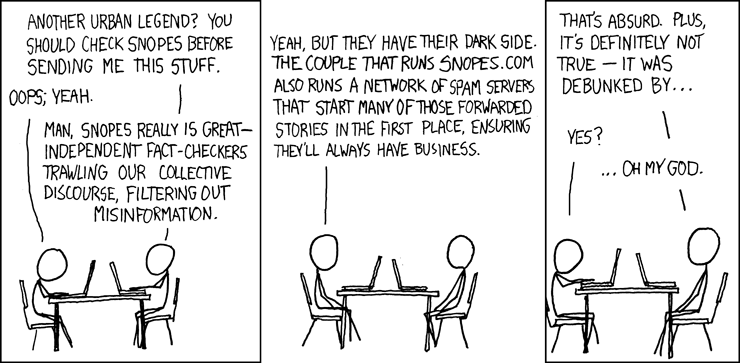
Whenever I get one of those cockamamie stories from family or friends — you know the ones, about how sending someone your bottle caps will save cancer patients, or that Congress is working on a bill to tax email — I reply with a pointer to snopes.com. Snopes is everyone’s favourite myth-debunking site.
And it’s good to have an easy response to these silly messages. Of course, they all tell you to “forward this to everyone you know,” and it’s so much nicer to pop off a reply to the sender with a link to Snopes, in the hope that at least that friend will (1) stop sending these things out, or (2) remove you from his address book, muttering a few unkind epithets along the way.
So I was particularly amused by this xkcd cartoon, poking fun at Snopes (click for full-sized version on xkcd.com):
One of the most persistent of the debunked myths is the $250 cookie recipe. Bogus story, but the recipe makes some good cookies.
.
Right about at the 100-day mark, President Obama already has his opportunity to make a Supreme Court appointment, with the impending retirement of Justice David Souter. It seemed likely that one of the justices would leave soon, though bets were on Justice John Paul Stevens, who’s been around much longer (since 1975, more than 33 years now), or Justice Ruth Bader Ginsburg, who’s recently been ill. Instead, we see the retirement of a healthy, not-so-old juror — Justice Souter will soon turn 70 and is younger than five of the other justices — who just wants to go home and relax.
Most of the news reports talk about how Souter was a “surprise” to the conservative side, for being less conservative than the president who appointed him (George Bush the First) and the Republicans who supported the appointment had hoped.
He may, indeed, have been a surprise to them, but as I look back on the the court and the decisions he was key to, I see him more as someone who put consistency and stability above ideology, and as someone who stood his ground as the court shifted around him. He did not, for example, vote to retain central aspects of the Roe vs Wade decision because he liked the decision, but because he thought it important to maintain the stability of the court’s decisions over time.
A look at the composition of the court is also in order. Note that Jimmy Carter got no appointments during his single term in office, and so seven of the sitting justices were appointed by Republican presidents — only Justice Ginsburg and Justice Stephen Breyer, who came during President Clinton’s administration, were appointed by a Democrat.
And yet we have Justice Souter and Justice Stevens (a Ford appointee) considered solidly on the “liberal” side of the court.
Yet that liberal side is not the side on which Justices Thurgood Marshall or William Brennan sat, for example. And yet note that Justice Brennan, considered very liberal, was appointed by President Eisenhower (a Republican)... and that Justice Byron White, a Kennedy appointee, dissented from ground-breaking liberal decisions, including both Miranda and Roe.
Justice White’s replacement by Justice Ginsburg has been the only shift back to the left for the current court. Apart from that, each change, from President Reagan’s replacement of Potter Stewart (of "I know it when I see it" fame) with Sandra Day O’Connor, to George Bush the Second’s replacement of Justice O’Connor with Samuel Alito, has moved the court more and more to a radically conservative position.
It’s no surprise that two justices appointed as “conservatives” to a more liberal court turn out to be “liberals” on an increasingly conservative court.
I hope that President Obama takes the opportunity to appoint a true liberal to the court. Not a radical liberal, and it seems clear that he wouldn’t want to anyway. But someone who will begin to move the court back to the center, where it belongs. That won’t happen with an attempt to please everyone with the appointment of a “centrist”.
.
The jury-duty news has been interesting of late.
First we hear that the U.S. Supreme Court declined to hear a case challenging a jury’s choice of the death penalty, where the choice was made by consulting a bible. Many of the articles about it give the mistaken impression that the jury decided the man’s guilt based on the bible; they did not (well, maybe they did, but not overtly). They consulted the bible to decide the appropriate punishment, and the bible pointed at death (it seems to do that a lot, and we’re just selective about applying it). Anyway, the defendant’s attorneys have appealed the decision up through the courts, and the Supreme Court has now shut down the appeals. Barring executive intervention, a man will soon be put to death because religious scripture says he should be.
In the United States, mind, not in Afghanistan.
Then we hear that Mr T was called for jury duty. He appeared, doing his duty, and he was considered and then dismissed. I wonder how a defendant would feel, seeing the former pro wrestler in the jury box. And what would the God-fearing Mr T do about referring to the bible in making a decision?
We’ll never know, because he wasn’t chosen. But he didn’t try to get out of it.
Our third guy did, though, try to get out of it. More than trying, he succeeded, but his excessively, um... brusque approach nearly landed him in jail: Erik Slye wrote out an affidavit to the Montana court stating his refusal to serve, and telling them to, in his words, “Leave me the F__K alone.”
No, really. In case you have trouble reading the handwritten affidavit, here’s what it says (errors as in the original):
Apparently you morons didn’t understand me the first time. I CANNOT take time off from work. I’m not putting my familys well being at stake to participate in this crap. I don’t believe in our “justice” system and I don’t want to have a goddam thing to do with it. Jury duty is a complete waste of time. I would rather count the wrinkles on my dogs balls than sit on a jury. Get it through your thick skulls. Leave me the F__K alone.
Contempt of court? I should say. And it gives “swearing an affidavit” new meaning.


I am not a number!
I am a free man!


(Click the image to see the blogroll.)