Showing posts sorted by relevance for query "technology in star trek". Sort by date Show all posts

Wednesday, April 18, 2007

.

Technology in Star Trek, the engines

More of the series on technology in Star Trek: the engines.

I've always thought there were both interesting and silly aspects to how Star Trek portrays the ship's engines. It makes sense that the “warp” engines are separate from the “impulse” engines (and they also have “thrusters”, which occasionally get used for very low-power propulsion). And the concept of the warp engines is a good one, which seems very consistent with the technology in general. I also like that the warp engines have limitations — and that the limitations have changed over time: in the original series, the ship's top sustained speed was around warp 6, though they could push it when they had to; Voyager can go faster, yet there's a theoretical limit that they can't achieve warp 10. “Transwarp” technology, which we've seen in Voyager's future (and in other cultures that have already developed it), can go to warp 10 and beyond.

The silly part, which was handled worse in the original series and isn't so bad in Voyager, is the whole “Scotty, I need more from the engines!” thing, usually demanded in the midst of a crisis. Scotty's response was often, “I'm giving them all I've got, Captain!”, or something similar, as though a crew were there shovelling coal (or anti-matter) into a furnace to try to get more pressure in there. It's silly because such technology would surely just be turned up to “max”, and that's that. Either you've got it turned all the way up or you haven't, and if you have, nothing else you do will change anything.

Aboard Voyager, the usual thing is to “divert more power” to a subsystem. I'm skeptical about that one... it seems sensible for some things — if there's limited power available, maybe expending more on the shields, say, makes sense when you're in danger of being blasted out of the galaxy, and maybe that really can make the shields hold longer — but it seems to be used far too often, even when the power systems aren't compromised. I'd think that the weapons systems would be self-contained, and diverting extra power to them wouldn't make them more destructive. Diverting power to the engines could go one way or the other, but I think I put it in the latter category, where it seems a bit silly.

Anyway, the limitation on the engines' performance and top speed are what make the premise in Voyager work. It's easy, in a science fiction story, to remove too many technological limitations and weaken the story. Star Trek has done that in some areas, but not with the engines... so it still makes sense that it will take them 70 years to get back home from where they wound up.

But one thing I don't get is why they'd ever travel below the maximum speed they can safely go. In the original series, I got the impression that travelling at warp 4 was as safe for the Enterprise as going warp 2. And yet Captain Kirk often said, “Get us out of here Mr Sulu. Warp 2.” Similarly, Voyager isn't always heading home at maximum warp, and there's not a clear explanation for that. Maybe it's a balance between speed and resource consumption, or something of a maintenance issue... but it seems to be handled inconsistently.

Friday, September 21, 2007

.

Technology in Star Trek, computers, part 2

One more in the technology in Star Trek series: computer programs. In part one about the Star Trek computers we mostly looked at the computers themselves. This time we’ll look at the programs.

Actually, it’s hard to separate the computer from the programming in most cases: the computers are integrated AI units that seem to do everything, simply at the utterance of a human-language sentence. Where we see direct references to programs, data structures, and the like are with the holograms. The emergency medical hologram — the doctor — is the best example.

As I said in part one, some things never seem to change. They appear still to have problems with memory leaks, or something very much related. Many times, they worry that the doctor’s program has been running for too long without rest, and they say that will cause “his program to degrade”. The most interesting thing is that this is, apparently, a permanent condition once it happens. That is, unlike with resource leaks today, it’s not just a question of “rebooting” the doctor, or even shutting his program down for a while and restarting it later, after a rest. Once his program should “degrade”, the damage would be, it seems, irreparable.

They can also “lose his program” if it stops running in the wrong state or at the wrong time, as if the power fails. There’s one episode where there’s a danger of that happening unless they can transfer his program to the mobile emitter in time. Again, this isn’t something they can recover from, so it’s truly a crisis situation.

Don’t these people take backups?

The programs also have the smoothest plug-in system around. New “subroutines” can just be dropped in on their own, and they work, adding entirely new function with no direct connection to the rest of the software. They can give the doctor starship command subroutines, and he suddenly has the skills he needs to command a starship. Or they can “delete his ethical subroutines” with no apparent side effects — he’s the same doctor in almost all ways, except that he’s now happy to do unethical medical practices.

In a similar vein, subroutines can be selectively “damaged”, and, again, apparently irretrievably. Overuse some portion of the program, and that portion could be damaged, possibly beyond repair.

The interesting thing about the spontaneous program damage is that it didn’t seem to be important to the storylines. It just occasionally added a bit of urgency that could have been accomplished with a less silly explanation. When we’re told that computer systems that advanced have that basic a design flaw, well, it’s kind of hard to suspend that bit of disbelief.

As Maggie has pointed out in the comments of earlier entries, the 24th-century crowd seems to have developed recursion into a sort of “silver bullet”. They’re having some difficulty with a computer program, someone says, “Try a recursive algorithm,” and, hey, that does the trick. And on top of that, trying it only takes two or three button-pushes. Wouldn’t it be nice if it were all that easy?

And I think this ends the “Technology in Star Trek” series. I’ve about milked it for all it’s worth by now.

Tuesday, August 28, 2007

.

Technology in Star Trek, computers, part 1

Yes! It's time for another in the series on technology in Star Trek. This time: computers, and the programming thereof. There’s enough to say on this that I think I’ll split it into two posts, leaving most of the discussion of software for the second one.

It stands to reason that computer technology will have improved unimaginably by the 24th century. After all, they were only first created in the mid-20th century, and look how far we’ve already come. When the Eniac took up a huge room, some 60 years ago, no one would have though that, less than a lifetime later, something far more powerful would fit in your pocket, that people would be wirelessly connected to the world while sitting in the park with a laptop, that some sort of computer would be in most things we own, from a car to a toaster.

And so we have the computer on Star Trek, which perfectly understands human language in context, which can translate among any languages in real time, which has super-advanced artificial intelligence. “Computer, analyze the juvenile life form in the next room, figure out what it will look like in its adult form, and project a hologram of it on the table here.” No problem.

And, yet, interestingly, the computer has to be told to make obvious adjustments in order to obtain valid sensor readings, to work around equipment failures, and the like (all “dialogue” here is made up on the spot, so don’t try to find it in any episodes):

Janeway: Computer, why are the sensors not reading the alien ship ahead?

Computer: There is ionic interference in this sector.

Janeway: Compensate for it.

Computer: Compensating...

Tuvok: Captain, sensors are now reading seven life forms in the alien ship, and they are powering weapons.

Damn! Compensated just in time, too, eh? I think that, in general, the crew “remodulated” things to resolve problems, and the computer “compensated”.

This perfect linguist of a computer appeared not to be able to say “yes” and “no”. I guess they don’t sound like “computer” words, do they?:

Janeway: Computer, transfer the doctor’s matrix to the mobile emitter.

Computer: Unable to comply.

Janeway: Is the mobile emitter working?

Computer: Affirmative.

Janeway: Is the doctor’s matrix destablizing?

Computer: Negative.

Janeway: Then why can’t you do the transfer?

Computer: Transfer protocols are offline.

After all, if a computer doesn’t sound like a computer, where’s the realism?

But the most amazing thing about the computers in Star Trek is how they’re programmed: the people just talk to the computer and tell it what modifications they want, and the computer understands and makes the changes. Oh, man, I want that kind of an integrated development environment. And we think Eclipse is cool, ha!

But with all that, there are some things that never seem to change. We’ll look at those next time.

Monday, April 30, 2007

.

Technology in Star Trek, sensors

More of the series on technology in Star Trek: the sensors.

If the Star Trek folks did a good job in retaining limitations in the engines, an area where they've failed the viewers miserably is the sensors. There were certainly limitations to the sensors in the original series, but Voyager has pretty much no limitations except when it suits the plot, in which case they make up reasons — sometimes lame ones — about why the sensors can't see something.

Seriously, here. The sensors can tell how many life forms there are, and of what species. They can tell how many dead bodies there are. They can tell exactly what sort of weaponry is available, and whether they are “powered up” or not. They can detect “energy signatures” and “weapon signatures”, and determine, say, that a Borg ship has been here recently, or that someone has fired a Federation phaser 'round these parts. They can scan a planet and tell Voyager just what level of technology they have there. Heck, they can even detect technology that Voyager doesn't have — it's a good trick, making scanners that can find things you don't even know about.

When they need to stick scanner limitations into the plot, well, we usually get “subspace interference” or some mysterious sort of “cloaking technology”. But sometimes, when the scanners can't find what they're looking for, the crew just needs to “recalibrate” or “remodulate” them — a process that apparently happens at the press of a button, and there's no explanation about what they're calibrated against, or what sort of “modulation” we're talking about.

The remodulation thing also magically changes the effectiveness of the shields and of the weaponry. The odd thing here is that with the removal of limitations of other sorts, there's still a ridiculous limitation that the captain has to give an order to “remodulate” something, at which point a crew member says, “Aye, captain,” and suddenly it's all better. As sophisticated as the equipment and the computer system are, wouldn't that happen automatically, with no specific human command and response?

This is where I find things the most maddening, and where it requires the greatest suspension of disbelief. It's simply a question that when it helps the plot for Voyager to know what's what, the sensors can give the information... and when it helps the plot for them to be in the dark, the sensors can't see it. And there's just no consistency to it. It's a part of the system that I just can't see as reasonable technology, even for the 24th century.

While I'm here, three unrelated Star Trek notes:

  1. Nice quote from the episode titled “Someone To Watch Over Me”: Seven of Nine is observing B'Elanna and Tom, by way of studying human mating behaviour. B'Elanna is annoyed when she discovers this, grabs Seven of Nine's notes, and reads them.
    B'Elanna: “Star date 52648, 0300 hours, intimate relations resume.” How the hell do you know when we're having intimate relations?
    Seven of Nine: There is no one on deck 9 section 12 who doesn't know when you're having intimate relations.
  2. I've just watched the episode titled “Blink of an Eye” (season 6 episode 12), and I consider it to be the best Voyager episode so far.
  3. You may have heard that the ashes of cremated actor James Doohan (Scotty from the original series), along with those of astronaut Gordon Cooper and about 200 other people, have just been sent into space. I love technology.

Monday, April 09, 2007

.

Technology in Star Trek

When I was a child, I loved science fiction movies. The original Star Trek TV series aired when I was around 10 years old, and I just ate it up. The special effects were quite good at the time, especially for television (compare it with its contemporaries, like Lost in Space and the short-lived The Time Tunnel), and it didn't bother me, at that age, that the acting was over the top and some of the stories were pretty trite.

I was sad when the original series left after three seasons, and was disappointed in the movies. By the time Star Trek: The Next Generation came around, about 20 years later, I wasn't interested. I saw a couple of episiodes, they didn't grab me, and I didn't pursue it. Neither did I watch the other versions, Deep Space Nine, Voyager, or Enterprise.

But in December a US cable TV channel, Spike TV, started re-airing the Voyager series from the beginning, and, as I happened to catch it at the first episode and am now armed with TiVo, I decided to record it and watch it. I've just finished watching the fourth season of the series. The special effects are still quite good, especially for television, the acting is still over the top, and some of the stories are still pretty trite. We still have our diverse crew, a true mark of the original series, where the senior officers included a black woman, an Asian man, a Russian, a Scotsman, a man from another planet, and a “good ol' country doctor.” In Voyager, the captain is a woman, we have a black man from another planet, a Native American, all manner of other mixtures... and the doctor is a computer-generated hologram.

The stories, too, follow the pattern from the original of highlighting diversity, tolerance, and enlightenment. But that's not what I want to focus on here. I thought it'd be interesting to look, in a series of posts, at some of the technology presented in the two — the original series and Voyager — and see what's changed, for the better or worse, and what's stayed the same.

With that introduction, I'll start simply, with the communications systems.

In the original series, everyone — even alien races never before encountered — generally spoke English. Sometimes there were explanations for that, as with worlds modelled on some image of Earth (“A Piece of the Action”, “The Omega Glory”, “Patterns of Force”, “Bread and Circuses”), or with super-intelligent beings or telepathy. But most often, there was simply no explanation. Voyager gave us an explanation, with the “universal translator” that's built into their “comm badges”. They don't explain how the translator also makes it look like the aliens' lips are moving in English as well, but we'll let that go.

The comm badges are quite nice, little hands-free devices that double as the decorative insignia on the shirts, as well as being translators, communicators, and tracking devices. The communicators in the original series, though, were more fun for kids to play with. They were very much like “flip phone” style mobile phones of today (and it wouldn't surprise me if the phone designers used the Star Trek communicators as their prototype), and we used to make our own toy versions out of wood and rubber bands. (We also used to beset each other with “Vulcan nerve pinches”, but that's not a technology issue.)

For long-range communication, they thought to explain the lack of propagation delay over the enormous distances by creating “sub-space radio” that bridged the light years for radio signals the way the warp drive did for the ship itself. Even so, there were limitations. When the Enterprise was far enough from Star Fleet outposts, it did take time to get messages through and responses back, and that sometimes fed into the story lines, requiring Captain Kirk to make field decisions without orders from above. Voyager had the same issues: sub-space communication won't go all the way to the far end of the galaxy where they've wound up, 60,000 light years from home, leaving them out of contact completely.

It's time to end this entry before it gets over-long, but I have notes about other Star Trek technology things to post about. One, not surprisingly, will be about the computer systems. So this series will be continued, as we continue our five-year mission: to explore strange, new worlds; to seek out new life, and new civilizations....

Monday, June 08, 2009

.

Computers in movies and television

In 2007, I had a series in these pages about technology in Star Trek. I remembered that series the other day, when I read an article in New Scientist about the science in Battlestar Galactica.[1]

The New Scientist article focuses on human physiology and psychology, and on gravity and g-forces. It doesn’t look at power, speed, computers, astronomical issues, or any of a number of other things that would have been fun to see covered. Oh, well.

But it made me think to come back to the idea of how technology is portrayed — in particular, how computers had been and are depicted in movies and television.

Star Trek, of course, and other futuristic stories, such as 2001: A Space Odyssey (which, at the time the movie was made,[2] was still set more than 30 years in the future), sported talking computers that showed varying degrees of intelligence. The Enterprise’s computer mostly responded to spoken commands and queries, but other computers in the Star Trek universe were semi-sentient to the point of being able to be confused or tricked, an angle that was central to the plot of more than one episode. And 2001’s HAL-9000, well... we all know what happened there, whether or not we understood what was happening.

But cinematic views of contemporary computers have always been somewhat odd, usually aimed at being obvious or flashy. In the old days, they always consisted of banks and banks of tape drives and flashing lights, long after real computers had few or none of those. As personal computers came around and more people had more realistic images of computers — boxes on their desks, rather than mysterious roomfuls of equipment — the tape-drives-and-lights depiction had to change.

Now, computers look like what we’re used to seeing, but what they can do seems just about unlimited. The stuff that’s comical now has to do with those limitless capabilities and the silly user interfaces.

Computers on television can search for anything, find anything, display anything. They can zoom in on the minutest details, rotate images in three dimensions to show any perspective, and go through millions or billions of data records or documents in no time at all. They understand commands or queries in human language, just as the Star Trek computer did, except we have to type the instructions, not speak them.

The interesting thing about that last bit is that it’s actually backward from what the real technology can do: we’re much better at having a computer turn the spoken language into the right words than we are at having the computer understand what those words and sentences mean. My former colleagues at IBM’s Watson Research Center have long had the ViaVoice products working quite well, but they’ve only recently begun a “grand challenge” project to get a computer to understand human-language questions well enough to play Jeopardy! competitively.

We often see police investigators zooming in on low-quality surveillance videos and “enhancing” a cropped portion in order to identify a face, read a sign or a car’s license plate, or the like. A certain amount of computer-enhancement can, indeed, be done, and technology for image processing is getting better all the time. That said, for the most part what they’re doing is ridiculous. Image data can only be extrapolated to a point, and the reality is that information that isn’t there can’t be created out of nothing. A low-resolution image can’t magically become high-resolution with the aid of a computer, and if you zoom in on a 30-pixel-square portion of a grainy, one-megapixel security-camera image, you will never, with any computer, get a clear image of the suspect’s face.

The same goes for the 3-D rotation: such manipulation is possible, and it’s done all the time when the 3-D data are available. But a two-dimensional source does not have that information, and, beyond approximation and guesswork, such an image can’t be rotated to show a side view.

When was the last time you did a search on your computer and wound up with a large blinking, beeping box in the middle of the screen, saying, “NO MATCH FOUND”? A pop-up box with an “OK” button on it, maybe, but we just don’t have them blink and beep repeatedly.

The other thing we don’t have them do is display the thing to be searched for — often a face or a fingerprint — on the left side of the screen, while rapidly flashing all the unmatched images we’re searching through on the right side. That may look cool on TV (which is why they do it), but in reality it would slow the search down so much that it’d be entirely useless. No one would ever design a real search program that did that.

Finally, in the movies people always seem able to go up to any computer, start any program, and use it expertly. They can even do this with special-purpose computers, not just ones that run Windows or Unix or MacOS. To address the most ridiculous case that comes to my mind: it would simply not be possible to connect your laptop to a space-alien’s computer and upload a computer virus that would take out the computer system and defeat the aliens.

Suspension of disbelief has its limits.


[1] The recent, well-received series, of course, with Edward James Olmos, not the horrible, short-lived one from the late ’70s, with Lorne Greene.

[2] And, for the record, the book came from the movie’s screenplay, not the other way around.

Wednesday, September 26, 2007

.

Technology in Star Trek: the “Whom Gods Destroy” edition

Yes, I said I was done with this series. And I was. But then what should happen? BoingBoing should point us to a Daily Mail (UK) article about a weapon in development by the US company Raytheon. It’s called the “Silent Guardian”:

When turned on, it emits an invisible, focused beam of radiation — similar to the microwaves in a domestic cooker — that are tuned to a precise frequency to stimulate human nerve endings.

It can throw a wave of agony nearly half a mile.

Because the beam penetrates skin only to a depth of 1/64th of an inch, it cannot, says Raytheon, cause visible, permanent injury.

But anyone in the beam’s path will feel, over their entire body, the agonising sensation I’ve just felt on my fingertip. The prospect doesn’t bear thinking about.

“I have been in front of the full-sized system and, believe me, you just run. You don’t have time to think about it — you just run,” says George Svitak, a Raytheon executive.

About 40 years ago, a similar device showed up in Star Trek, first in 1966, in the first-season episode “Dagger of the Mind”, and then in early 1969, in the third-season episode “Whom Gods Destroy”. The latter specifically uses it as a torture device, the character who uses it pointing out that, as it causes “no tissue damage”, it can be kept up “indefinitely.”

If this is real (it is in the Daily Mail, after all, so we’re not so sure), and if, as Raytheon claims, it causes no permanent damage, it certainly could be used for all sorts of purposes, a few of them benign. Most of them, not. Most of them, in fact, are quite frightening. The idea that only the “good guys” will have such a device is quite obviously deluded. And as the reporter points out, the idea that the good guys will always be good is equally questionable:

With the Taser, the rules in place in Britain say it must be used only as an alternative to the gun. But what happens in ten or 20 years if a new government chooses to amend these rules?

It is so easy to see the Taser being used routinely to control dissent and pacify — as, indeed, already happens in the U.S.

And the Silent Guardian? Raytheon’s Mac Jeffery says it is being looked at only by the “North American military and its allies” and is not being sold to countries with questionable human rights records.

Countries with questionable human rights records... like, say, the U.S.?

I am so pleased that we are catching up with that bit of Star Trek technology. So pleased. [And you’ll note that, unlike the rest of the entries in this series, this one does not get the “Whimsy” label.]

Saturday, August 11, 2007

.

Technology in Star Trek, holograms

Hm, more controversy yesterday than with my political or religious commentary. Well, we'll cut the conflict for today: it's been a while, but it's time for more of the series on technology in Star Trek. Today: holograms.

I understand that the “holodeck” was introduced in The Next Generation, providing the crew with a means of recreation. Having not seen that series (I've seen a few episodes, but not many), I encountered the holodeck in the Voyager series, where it was far more important: they would have to travel for years to get home, and seriously needed a good schedule of “R and R”. And so it's not surprising that the holodeck played a significant part in many of the Voyager episodes.

More than that, though, the ship's doctor was killed in the pilot episode, and the doctor throughout the series was the “emergency medical hologram”, designed to assist the real doctor in emergency situations. Fitting enough: the whole series was a prolonged recovery from an emergency situation.

All that said, both the doctor and the holodeck were taken to pretty silly extremes. I'll have lots more to say about the doctor when I get to entries (yes, probably more than one) about the computer programs, so I shan't get ahead of myself here; I'll stick to the holographic aspects, specifically.

Let's start with something that's often convenient to the plot but conceptually ridiculous, owing to the nature of holograms: that they can alternately be solid and not. That someone can take a swing at the doctor, for instance, and have his fist go right through the hologram, and in the next moment be decked by a blow from the very same hologram. Yes, this is the 24th century, and lots will have been discovered 'tween now and then. But I can't accept solid holograms, much less ones that shift back and forth at will.

Then there's the issue of projecting the hologram, which requires some pretty sophisticated and specialized equipment, not available in places like the mess hall and the loo. In particular, the doctor can only appear in the holodeck, in sick bay, and on the bridge, the only places on the ship where the necessary equipment is installed. I'm guessing that that proved an annoyance to the writers, particularly as the doctor became a popular and more significant character.

They solved this with a sort of deus ex machina plot element. Someone from the 29th century came back in time, and while he was there the Voyager folks snagged from him a “mobile emitter”, a device the size of a “comm badge” that could project the doctor anywhere he wanted needed wanted needed to be. The ridiculous part of the mobile emitter is that the doctor wore it on his own sleeve — that is, the emitter was placed (solidly; see above) on the very hologram it was projecting. Uh-huh. (Making it 29th-century technology, on the other hand, was actually clever, as it completely explained why there was only one, and why they couldn't just make (or replicate; the replicators were not without limitations) another.)

Another oddly thought out thing was that when the doctor's program had troubles, his image would flicker and fuzz (and make electric-arc sorts of noises), as if he were a failing light bulb. That seems unlikely. Maybe that would happen if the projectors were having trouble, but troubles with the program (it would often “destabilize”, but that's for later discussion) would more likely manifest themselves in other ways (which they sometimes did).

Finally, there's the holodeck itself. It's of limited size, and yet the environments projected there could be vast, and the crew would move through them as though that were so. OK, maybe the holodeck just gave the illusion that the environment was large, the crew only thought they were walking for miles, and we saw the situation through their perception. Seems like a stretch, but, hey, we have to give the writers some latitude, eh?

Saturday, August 18, 2007

.

Technology in Star Trek, the Borg

More of the series on technology in Star Trek: the Borg.

I only have a few, brief things to say about the Borg, because, after all, resistance is futile. The Borg, like the holodeck, was something introduced in The Next Generation and exploited in Voyager — coincidentally, the Borg come from the Delta Quadrant, the very place where Voyager is stuck and is trying to get home from. Lots of fun prospects there, and Voyager even picks up a poor orphaned former-human Borg waif, called “seven of nine, tertiary adjunct of unimatrix 01” — or just “Seven” to her friends, though she wasn't crazy about the term.

The Borg in general, and Seven of Nine in particular (her character was added to replace Kes, joining in season 4), drove quite many storylines, and the technology was used to resolve a number of situations. One really can't say too much about this blending of biology and technology — it's certainly an area that screams for suspension of disbelief, and that's fine.

So, here, those few comments:

  1. “Just give me about five seconds to reprogram some of my nanoprobes, and we'll sort things out tout de suite. [momentary pause] OK, there. Great, it worked, and just in time for the light-hearted end-of-episode moment.”
  2. "We're very sorry, Seven, but you're not a Star Fleet officer, so you can't wear one of our horrible dowdy outfits. I tell you what: we'll design you a tight, form-fitting thing that will make your boobs stick out nicely, OK?"
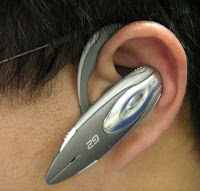
  3. bluetooth earpieceI'm sure no one imagined this in 1989, when the Borg first appeared on TNG, but, well, do you think there was a bit of prescience there?

Wednesday, April 11, 2007

.

Technology in Star Trek, transporter

Continuing the series on technology in Star Trek: the transporter technology.

In the original series, the transporter appeared able only to transport things to or from the transporter room. One had to be standing on one of the “pads” in order for it to work (and I recall an episode in which they were transporting someone unfamiliar with the transporter, and someone had to tell him to move over and stand on the pad). It was apparently a touchy mechanism, and someone had to be operating the controls and watching what was happening.

In Voyager, some of these limitations seem to be lifted. They could, and often did, transport people or things “directly to sick bay” or “into cargo bay 2”. They could transport an entire shuttlecraft from a planet's surface into the cargo bay. They could transport someone from the bridge to sick bay. And, while the transporter room was still there and appeared still to be attended by a transporter operator, Ensign Kim often operated the transporter from his controls on the bridge.

This didn't seem like a good change to me. It allowed for rescue mechanisms that weren't available in the original series, but it opened the whole thing up to inconsistencies and odd questions. If they can transport someone fron one part of the ship to the other, why did people have to race down to engineering during an emergency? When every second counted, why didn't they just transport them there? Why did security teams have to spend valuable time walking to where the intruder was, rather than being instantly transported to a spot nearby? And why have a crew member standing in the transporter room when the whole thing can be controlled from the bridge?

Sometimes simpler is better, in stories like this, and sometimes removing too many limitations to the technology just breaks the whole thing apart. And by the way: I actually preferred the visual effect of the transporter in the original show to the one on Voyager. The latter was snazzier, but the image of people dissipating into particles better fit my image of what the transporter was doing than did the shimmer of blue light.

Sunday, August 31, 2008

.

Carnivals!

Remember my silly Technology in Star Trek series? Well, maybe I should have tried for a book deal instead of blogging it: I hadn’t known then, but there’s a book called Science of Star Wars. Scientific American has posted excerpts from the book. Check it out on the SciAm site. [Thanks to BoingBoing for the link.]

Pointers to this fortnight’s blog carnivals:

Tuesday, October 06, 2009

.

Instant DNA scanning?

While we’re talking about Sunday’s All Things Considered, consider this thing: an item about Plummers Island, a small piece of ground near the banks of the Potomac River. It seems that some folks have catalogued what they call “DNA bar codes” for all the plant species on the island.

Why they call them “bar codes” isn’t clear, and the metaphor doesn’t seem right to me. I might say “DNA fingerprint”, or, perhaps, as a computer-security type, “DNA digest”. In any case, the point is that they’ve taken, from the full DNA sequence, a “marker” that is sufficient to uniquely identify each species. Which, when you think about it, is very cool.

What’s more, they’re looking at doing it super-quickly, even on the fly:

"We have to sequence that DNA to actually identify the plant," Kress says. "We’re not there yet in terms of me picking a leaf off the ground and telling you immediately from its DNA bar code what that is. We would have to take it back to the lab, sequence it. But technology is heading in the direction where we expect [that] what now sits on top of a desk as a DNA sequencer will eventually fit in the palm of your hand."

Within a few years, Kress imagines kids wandering through forests around the world with portable scanners that could analyze a sample of any plant, check it against the DNA database, and know within a few seconds what species they’re looking at.

Mr Spock with a tricorderNow, what that makes me think about is Star Trek tricorders. I remember how cool I thought it was, when I was 10, that Mr Spock could walk around with a hand-held device, supported by a strap over his shoulder, press a button on it, have it make a modulated whistling noise for a moment, and then announce whatever was appropriate about the surroundings. He could tell us the composition of the rocks and the air, the nature of the plants and animals in the area, the number of humanoids hiding nearby.

“Fascinating,” he would often say, as he operated his tricorder and looked at the readings.

And now, John Kress, Smithsonian Institution botanist, tells us that before too long, we’ll be able to do that — at least a little of that.

Fascinating.