
 I’m at the IETF meeting in Prague this week, so there’s little blogging to be done. But I wanted to note that Eric Clapton turns 66 today, and to give you two of my favourites of his performances. Enjoy.
Wednesday, March 30, 2011
.
Clapton is God!


Friday, March 25, 2011
.
Happy Eltonmas
Today is Sir Elton John’s birthday; he’s 64. Here are two of my favourites of his songs. Enjoy the next eleven and a half minutes.
Wednesday, March 23, 2011
.
Snow, Donald Trump, and climate change
It’s snowing lightly in the New York area this morning, and it expected to continue through the night and into tomorrow. We might get some early closings of the schools, which would mean I don’t play volleyball tonight; that’s sad. And, of course, though it’s not (yet) sticking to the roads, it’s doing its part to mess up traffic, or so I hear on the radio. Still, I like snow. It makes the world look pretty. And it’s expected, here, at this time of year.
Donald Trump was on the local suburban radio station this morning, promoting his television show by having a chat with the morning-drive personalities
(DJ
being such an obsolete term). But during the greetings, he started things by pronouncing that global warming is hooey (not his word, but I forget the specific words he used). It’s ridiculous, of course, he said: look at this snow, and it’s spring. And warming, well, this was the coldest winter I can remember.
I guess Donald Trump has just fired all the scientists.
But, see, here are some of the things that are not true:
- It is not true that it’s unusual to have a bit of snow in our area at the end of March, or even the beginning of April.
- It is not true that this was the coldest winter on record, or even for many years, and if it’s the coldest he can remember, he has a short memory.
- It’s not true that Donald Trump is a climate scientist, or any kind of scientist: he’s a businessman, and is apparently good at that. Others are good at other things, such as studying climate.
And here’s what is true:
As a businessman, Donald Trump has a strong interest in making people think there’s no problem. Regulations that address climate change at the expense of his business interests obviously won’t be making him happy.
I prefer the term global climate change
, which gets us away from the idea that everything is monotonically warming, and that any time it’s unusually cold we should call the whole idea into question.
But what I really prefer is that we not pay attention to what businessmen such as Donald Trump — or clergymen such as Cardinal George Pell, or politicians such as Senator James Inhofe, or actors, or sports figures — have to say about science. Look to the scientists in reference to the scientists, and give preference to those who specialize in the field in question.
As with most topics, in the case of climate change you can certainly find disagreement among scientists as well. Unanimity is rare. But the vast majority of those qualified to weigh in will tell you that global climate change is a problem, and that we can and should work toward fixing it.
We don’t need to hear from someone who runs a business competition on television.
Tuesday, March 22, 2011
.
Send me an e-mail?
The New York Times has not just gone astray with its payment scheme; it’s gone completely off the deep end, gotten lost in the forest, fallen off the cliff and into a pit, and is knee-deep in any other mixed and fractured metaphor you can devise... linguistically.
See, they have recently updated their style guide, removing, according to editor Philip Corbett, some aging or outdated technical terms,
such as CD-ROM, floppy disk, Dictaphone, Usenet, newsgroups, VHS, CAD-CAM and I.S.D.N.
Yes, they used to use periods in ISDN
, as they still do in I.B.M.
, I.P. address
, C.P.U.
, and others. But I’m happy to see that they’re eliminating the dots in USB
, URL
, and PDF
.
They also agree with me on capitalizing Web
and Internet
.
But here’s where they now err:
We no longer have to write about people sendingan e-mail message— we can call itan e-mail.The term is also acceptable as a verb. (For now, at least, we are keeping the hyphen for this and similar coinages like e-commerce and e-reader.)
I’m apathetic, disinterested on the hyphenation issue. I, myself, omit the hyphen and prefer email
, but I think it’s fine either way. But I insist that email
, avec hyphen ou sans, be used in a parallel way to mail
. It only makes sense, yes? And one would never say, I sent him a mail.
Of course not.
A letter
is parallel to an email message
, and they should keep it that way. If one wants to be shorter, it’s easy: I sent him email,
works fine, just as I sent him mail,
does.
But the New York Times is giving in to sloppy, lazy usage, such as is unbecoming the Gray Lady.
Oh, Noes!
Monday, March 21, 2011
.
The ultimate Hamantash
Long-time readers are well aware of three things, at least, about me:
- I’m flamingly atheist; I think religion is silly, at best, but
- I grew up in a Jewish family; also,
- I’m a math geek.
The combination of the first two can sometimes be a little odd. There are many ways in which the Jewish culture stuck, though the belief system never took hold at all. I love Passover seders, for instance, especially if I can be irreverent about them (more about that in a few weeks). I look forward to certain traditional foods (while at the same time relishing shellfish and anything related to pork). That sort of thing.
One favourite food has always been Hamantashen: triangular pastries associated with the Jewish festival of Purim, filled with poppy-seed paste or fruit filling (prune, cherry, apricot, or raspberry, usually). They’re little hand-held, individual fruit pies, and well-made ones are true delights.
It’s Purim now (well, this past weekend), and the Hamantashen are in the air. And Seattle food blogger Deborah Gardner has tied it all in with the math-geek bit to make the ultimate Hamantash (that’s the correct singular; Hamantashen
is plural (I’m a language geek, too, remember)): the Sierpinski Hamantash, modeled on the Sierpinski triangle.

Doesn’t it look grand? ! חג שמח
Friday, March 18, 2011
.
The New York Times paywall cometh
Yesterday, the NY Times sent this message by email to all registered users. An excerpt:
This week marks a significant transition for The New York Times as we introduce digital subscriptions. It’s an important step that we hope you will see as an investment in The Times, one that will strengthen our ability to provide high-quality journalism to readers around the world and on any platform. The change will primarily affect those who are heavy consumers of the content on our Web site and on mobile applications.
Here’s their FAQ list and the prices. As you can see, the minimum charge is $15 per month, which comes to $180 per year. That’s a lot, especially compared with free
. Part of the charge is for use of smartphone or tablet apps, and they do not offer a subscription that’s web only.
Cory, at BoingBoing, doesn’t think it will work, and I agree with him. There’s bound to be confusion about how much you can see. For instance, while, according to the FAQ, you’ll always be able to read things that someone posts to a blog or that you get from a Google search, they will count against your 20 free articles a month. So if you’re not a subscriber, you can read 20 articles from the Times site, and then read 20 (or 40, or 80) more posted on someone’s blog... if you do it in that order. But if you read the articles from the 20 blog posts first and then want to snag an article directly off the Times site, you’ll have to pay. You gonna keep track of that?
Well, they say they’ll keep track of it for you, but, really, it seems a complicated mess.
Apart from that, I wonder about the links I’ve already posted. I presume that blog links will be identified in a way that the site can recognize, tagged with a token of some sort. It seems unlikely that using the referrer field that the browser sends would be reliable enough for them. But all those old Times links I’ve been posting for the last five years lack any sort of tag, so will those suddenly be blocked by the paywall? Probably, and that will be very irritating.
I also take exception to their characterization of the change as affecting primarily heavy consumers of the content on our Web site.
20 articles a month is nothing, and I would not call someone who reads one article a day a heavy consumer,
in any sense. No, this will have a profound effect on the habits of a great many casual Times users, who check out a couple of items a day or so. If I want just 5 articles a month beyond the 20 free ones, I’ll have to pay $15 each month for that.
I likely won’t. I almost assuredly won’t.
So the result will be that the Times will no longer be my go-to
news source for background on what I say in these pages. I’ll look to other sources instead. And I’ll do that with sadness and regret, because I think the New York Times is the best source around... and that’s the best reason I can think of for them to look for ways to fund their content other than by charging for it, article by article. They’re a business, yes, but they’re also a public service, and an important one.
Or perhaps it’s that they’re not a public service any longer. Sigh.
Thursday, March 17, 2011
.
Republicans vs NPR
I sent the following message, last week, to my congressional representative, Nan Hayworth (R-NY 19):
The recent departure of executives from National Public Radio, and the events that triggered them, have fueled discussion in Congress about eliminating its federal funding. That would be a disastrous decision. Public radio and television provide and important service to the American public, with news, arts, and nature programming that is not connected to commercial interests. Their news agencies, in particular, benefit from their ability to remain impartial. Federal funding is entirely appropriate and necessary for these organizations, and Congress must not eliminate nor significantly reduce that funding. Ms Hayworth, please tell me your viewpoint on this matter, so that I may understand where you stand. And I urge you to stand on the side of the American public’s need for the high-quality news and arts programming that NPR and PBS provide.
I got no response. Or perhaps I did: today, the U.S. House of Representatives passed a bill to eliminate federal funding for NPR:
The House voted on Thursday to cut off funding for National Public Radio, with Democrats and Republicans fiercely divided over both the content of the bill and the manner in which it was brought to the floor.
Under the measure, sponsored by Representative Doug Lamborn, a Republican from Colorado, stations could not buy programming from NPR or any other source using the $22 million the stations receive from the Treasury for that purpose. Local NPR stations would be able to use federal funds for operating expenses, but not content.
The time has come for us to claw back this money,said Representative Marsha Blackburn, a Republican from Tennessee.
According to the voting, representative Hayworth voted against it. I’m not surprised, as she’s a newly seated Republican. But it’s very clear that she is not representing her district, which is very much in support of National Public Radio.
It matters little, really, because the measure will almost certainly not pass in the Senate, and so it will die. But what these idiot Republicans are doing is unfortunate, frightening, dangerous. And the partisanship that has settled in our legislatures since 2000 is the most dangerous part of all.
Monday, March 14, 2011
.

Friday, March 11, 2011
.
Mathematics and advertising
I occasionally post here about abuse of mathematics (such as this post, and this one, and this one). I occasionally post about silly advertising (try here and here). And sometimes I get to combine them in an item about abuse of mathematics in advertising (this is a good example).
The other day, the excellent web comic XKCD covered the combo very nicely, and included some of the things I often whine get huffy kvetch whine and get huffy about:
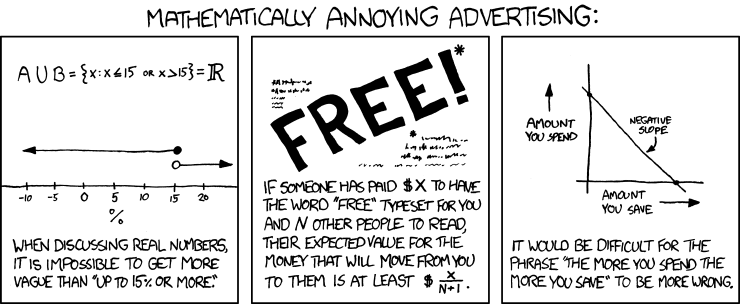
Hold the mouse over the comic to see Randall Munroe’s extra
text, present in most of his drawings. Click the comic to visit his web page. And while you’re at it, you might check out my other favourite XKCD comics: Sandwich (it’s a Unix joke), Snopes, Correlation, Can’t Sleep (warning: only extreme geeks will get this), and Spinal Tap Amps.
Thursday, March 10, 2011
.
Illinois Governor Signs Capital Punishment Ban
Yesterday, Illinois joined the civilized world, including 15 other states, by abolishing the death penalty. Their reason? One of sense:
Since our experience has shown that there is no way to design a perfect death penalty system, free from the numerous flaws that can lead to wrongful convictions or discriminatory treatment, I have concluded that the proper course of action is to abolish it,Mr. Quinn [Illinois Governor Pat Quinn] said in a statement.
In 2000, at the same time that Texas Governor George W. Bush was crowing arrogantly that every one of the people executed in his state during his reign — well over 100 — was guilty and deserved to die, the governor of Illinois at that time, George Ryan, suspended the death penalty because DNA evidence proved that a disturbing number of the death-row inmates there were, in fact, innocent.
Before then, George Pataki won the election for governor in New York with the promise of reinstating the death penalty here. And our state’s top court subsequently declared the law unconstitutional. No one has been executed in New York since 1963. The Massachusetts law has also been declared unconstitutional by its state courts.
The thirteen other states that do not have death penalty statutes at all are Alaska, Hawaii, Iowa, Maine, Michigan, Minnesota, New Jersey, New Mexico, North Dakota, Rhode Island, Vermont, West Virginia, and Wisconsin.
In contrast, Texas has killed 466 inmates since 1976. Virginia is a very distant second, at 108. In fact, Texas has executed more people than the next six states, combined (Virginia, Oklahoma (96), Florida (69), Missouri (68), Alabama (50), and Georgia (49)).
Illinois executed 12 prisoners between 1976 and Governor Ryan’s moratorium in 2000. Hooray for them for making it clear that they’ll kill no more.
Wednesday, March 09, 2011
.
“Hey, that’s my camera, Charlie!” “This is my farm, Clyde!”
Here: What do you do when people (such as animal-rights activists) take pictures of your farm in order to document abusive practices?
The answer, of course, should be obvious: you make it a felony to photograph farms.
Yes, the Florida state senate is considering a bill, SB 1246, that will do just that. From the Times:
Photographers — perhaps including some ghosts from Farm Security Administration days — are astir at news of a bill introduced by State Senator Jim Norman of Florida that would make it a felony to take a picture of a farm without the owner’s permission.
The bill is short, so let’s include the text, as introduced in the Florida Senate yesterday, here in its entirety. Paragraph (2) is the operative one.
A bill to be entitled
An act relating to farms; prohibiting a person from entering onto a farm or photographing or video recording a farm without the owner’s written consent; providing a definition; providing penalties; providing an effective date.
Be It Enacted by the Legislature of the State of Florida:
Section 1. (1) A person who enters onto a farm or other property where legitimate agriculture operations are being conducted without the written consent of the owner, or an authorized representative of the owner, commits a felony of the first degree, punishable as provided in s. 775.082, s. 775.083, or s. 775.084, Florida Statutes.
(2) A person who photographs, video records, or otherwise produces images or pictorial records, digital or otherwise, at or of a farm or other property where legitimate agriculture operations are being conducted without the written consent of the owner, or an authorized representative of the owner, commits a felony of the first degree, punishable as provided in s. 775.082, s. 775.083, or s. 775.084, Florida Statutes.
(3) As used in this section, the term
farmincludes any tract of land cultivated for the purpose of agricultural production, the raising and breeding of domestic animals, or the storage of a commodity.Section 2. This act shall take effect July 1, 2011.
Get all your Florida farm picture-taking done by June, now.
[I’ll note in passing that this also seems to make it illegal for someone to snap pics of your back-yard marijuana crop. Just sayin’.]
Update, 14:20 — Adding something I said in a comment elsewhere:
When I was in college (at University of Florida), I would see a great sunflower farm as we drove up I-75. When the sunflowers were blooming in row after row, it was really beautiful and striking.
The idea that if one’s passenger should snap a shot of that on the way by, without first stopping at the farmhouse for a written photo release, then one might be liable to prosecution for a felony... is pretty insane.
And the idea that they’re even considering this is equally insane. This is not the country I grew up in.
Tuesday, March 08, 2011
.
You’re in a maze of twisty little passages, all alike.
There’s a phrase given to us by the venerable computer game called Adventure, which fits many situations. The game, in which one explores caverns, searches for treasures, and solves puzzles to obtain the treasures and bring them back to the surface, contains two mazes.
Most adventurers find the first maze when they go south from a particular room in the cave. You’re in a maze of twisty little passages, all alike,
says the computer, adding that there are passages leading off in all directions. One’s first thought is to go north to retrace one’s steps, but, well, the passages are twisty (and little), and going north from there only lands one in another room within the maze. Again, You’re in a maze of twisty little passages, all alike.
The directions are not random, and there actually is a well-defined maze here, which one can map. Enter the maze while carrying as many items as you can, and you can drop the items like bread crumbs. You have to keep carrying the lamp in order to see, but as you drop the rest, one by one, the rooms become distinct:
You’re in a maze of twisty little passages, all alike.
There is a bottle of water here.You’re in a maze of twisty little passages, all alike.
There is tasty food here.You’re in a maze of twisty little passages, all alike.
There are some keys on the ground here.
Interestingly, the maze comprises two lobes, connected by a single passage. Because the only (non-magic) exit from the maze is the way you came in, wandering into the far lobe makes it much more difficult to ever get out, and you’re likely to run out of battery power in your lamp, fall into a pit in the dark, and die.
Such is the maze of twisty little passages, all alike.
The second maze is interesting only for its differences. It’s also entered by heading south, from a different starting room. Its map is much more complex than that of the other, with many more passages interconnecting the rooms, though with fewer rooms. When you enter it, you see, You’re in a maze of twisty little passages, all different.
But this time you don’t have to leave bread crumbs
; you have only to read the descriptions carefully:
You’re in a maze of twisty little passages, all different.
You’re in a maze of little twisty passages, all different.
You’re in a twisty maze of little passages, all different.
You’re in a little twisty maze of passages, all different.
...and so on.
The all-different maze is cute, and, as I said above, mostly there for its contrast with the all-alike maze (most adventurers stumble into the all-alike one first). There’s a treasure in the all-alike maze, so you have to go in there (and kill the pirate) in order to get it. There’s nothing you need in the all-different maze, and experienced adventurers just avoid it.
And anyway, it’s the first description that’s stuck with us as a catch phrase
: You’re in a maze of twisty little passages, all alike.
When you’re having a discussion that keeps going around in circles with no hope for resolution: You’re in a maze of twisty little passages, all alike.
When you’re debugging a problem, but everything you try just makes the problem happen without adding any clue as to why: You’re in a maze of twisty little passages, all alike.
When you’re trying to deal with bureaucracy, and every attempt to get something done just sends you to another office that you know won’t help any more than the last did: You’re in a maze of twisty little passages, all alike.
Very useful sentence, that.
Sunday, March 06, 2011
.

Friday, March 04, 2011
.
Reasonable network management
Back in December, the U.S. Federal Communications Commission released a Report and Order
specifying new rules related to network neutrality. The rules have since been challenged in court in separate suits by Verizon and Metro PCS. They’re also under attack by the House of Representatives, though whatever they do is unlikely to pass the Senate and the president.
The Report and Order is quite long and involved, a typical federal document that runs to 194 pages (here’s a PDF of it, in case you’d like to read the whole thing). On page 135 there begins a statement by FCC Chairman Genachowski, which contains, on page 137, five points, key principles
, as Mr Genachowski says, that lead to key rules designed to preserve Internet freedom and openness.
That’s sort of an executive summary of the document.
I’ll note principles four and five here:
Fourth, the rules recognize that broadband providers need meaningful flexibility to manage their networks to deal with congestion, security, and other issues. And we also recognize the importance and value of business-model experimentation, such as tiered pricing. These are practical necessities, and will help promote investment in, and expansion of, high-speed broadband networks. So, for example, the order rules make clear that broadband providers can engage in
reasonable network management.Fifth, the principle of Internet openness applies to mobile broadband. There is one Internet, and it must remain an open platform, however consumers and innovators access it. And so today we are adopting, for the first time, broadly applicable rules requiring transparency for mobile broadband providers, and prohibiting them from blocking websites or blocking certain competitive applications.
In apparent response to those points, and taking transparency
seriously, Verizon Wireless has recently updated their Customer Agreement (Terms and Conditions). If you scroll down to the bottom of that document, you’ll find a section called Additional Disclosures
, the first paragraph of which says this:
We are implementing optimization and transcoding technologies in our network to transmit data files in a more efficient manner to allow available network capacity to benefit the greatest number of users. These techniques include caching less data, using less capacity, and sizing the video more appropriately for the device. The optimization process is agnostic to the content itself and to the website that provides it. While we invest much effort to avoid changing text, image, and video files in the compression process and while any change to the file is likely to be indiscernible, the optimization process may minimally impact the appearance of the file as displayed on your device. For a further, more detailed explanation of these techniques, please visit www.verizonwireless.com/vzwoptimization
That URL at the end lacks the http
at the beginning and has not been made into a clickable link, but if you copy/paste it into your browser’s address bar, you’ll be redirected to a long page called Explanation of Optimization Deployment, full of technical details. It’s perhaps the most detailed and technical disclosure I’ve seen presented to consumers, full of terms such as Internet latency
, quantization
, codecs
, caching
, transcoding
, and buffer tuning
.
I have to say that the policy looks reasonable. They say that they apply their optimization
(not really the right term, here, but that’s the marketing spin) to all content, including Verizon Wireless branded content.
They compress images and transcode video to reach a compromise between fidelity to the original content and what’s likely to be useful on a mobile device, conserving transmission resources by doing it. But it also benefits the consumer by way of reduced data charges. They also, basically, stream the content (buffer tuning
), so if you stop a video in the middle you don’t have to transmit (nor pay for the transmission of) the unwatched portion.
The only disadvantage of any of this as I see it is that there’s no way to turn it off. If you notice degradation of your video content and want to watch the original — and are willing to pay for extra data transmission that entails — you can’t.
As a first step, this looks good: it’s a reasonable policy that preserves the essence of neutrality and fits the reasonable network management
model. Of course, Verizon Wireless may just be testing the water, introducing changes a little at a time, with the most benign changes first. We’ll have to see.
Tuesday, March 01, 2011
.
URL shorteners
If you’re a twit a Twitter user, you’ve likely used one or another of the URL shorteners out there. Even if you’re not, you may have run across a shortened URL. The first one I encountered, several years ago, was tinyurl.com, but there plenty of them, including bit.ly, tr.im, qoiob.com, tinyarrow.ws, tweak, and many others.
The way they work is that you go to one of them and enter a URL — say, the URL for this page you’re reading:
http://staringatemptypages.blogspot.com/2011/03/url_shorteners.html
...you click a button and get back a short link, such as this one:
http://bit.ly/eqHg3S
...that will get users to the same page. The shortened link redirects to the target page, and won’t take up too many characters in a Twitter or SMS message. It also may hide the ugliness of some horrendously long URL generated by, say, Lotus Domino.
On the other hand, it will also hide the URL that it points to. When you look at the bit.ly link above, you have no idea where it will take you. Maybe it’ll be to one of these august pages, maybe it will be to a New York Times article, maybe to a YouTube video, and maybe to a page of pornography. Click on a shortened URL at your own peril.
In addition, any URL you post, long or short, might eventually disappear (or, perhaps worse, point to content that differs from what you’d meant to link to), but if you post a load of shortened URLs to your blog or Twitter stream and then the service you used goes out of business, all your links will break at once. That didn’t used to happen, but can now. And because some of them use country-code top-level domains (.ly, .im, .tk, and .ws, for example), the services may be subject to disruption for other reasons — one imagines that the Isle of Man and Western Samoa might be stable enough, but if you’ve been watching the news lately you might be less sanguine about Lybia.
The more popular URL shorteners can also collect a lot of information about people’s usage patterns, using cookies to separate the clicks from distinct users. If they can get you to sign up and log in, they can also connect your clicks to your identity. There are definite privacy concerns with all this. URL shorteners run by bad actors can include mechanisms for infecting computers with worms and viruses before they send you on to the target site.
Of course, any URL can hide a redirect, and any URL can hide a redirect to a page you’d rather not visit. It’s just that URL shorteners are designed to hide redirects, and there are no lists of best practices
for these services, along with lists of reputable shorteners that follow the best practices.
What would best practices for URL shortening services look like? Some suggestions, from others as well as from me:
- Publish a usage policy that includes privacy disclosures and descriptions, parameters, and limitations for other items such as the ones below.
- Provide an open interface to allow browsers to retrieve the target URLs without having to visit them. This allows browsers to display the actual target URL on mouse-over or with a mouse click. Of course, shortening-service providers might not want you to be able to snag the URL without clicking, because they may be getting business from the referrals. Services such as Facebook, while not
shorteners
, front-end the links posted on their sites for this reason. So we have a conflict between the interests of the users and the interests of the services. - Filter the URLs you redirect to, refusing to redirect to known illegal or abusive sites. Provide intermediate warning pages when the content is likely to be offensive, but not at the level of blocking.
- Provide a working mechanism for people to report abusive targets, and respond to the reports quickly.
- Don’t allow the target URL to be changed after the short link is created.
- Related to the previous item, develop some mechanism to address target-page content changes. This one is trickier, because ads and other incidental content might change, while the intended content remains the same. It’s not immediately clear what to do, or whether there’s a good answer to this one.
Meanwhile, I never use URL shorteners to create links, and I try to avoid visiting links that are hidden behind them. I like to know where I’m clicking to.
Update, 11 March, this just in from BoingBoing:
Dear readers! URL shorteners’ popularity with spammers means we’ve blocked some of the big ones (at least temporarily) to cut down on the spammation. Sorry for the inconvenience! While we plan a long-term fix, just use normal URLs. You are welcome to use anchor tags in BB comments, too.
Subscribe to:
Posts (Atom)