A glance at any Japanese text makes it clear that the script is fully alien to us, and a reading of some of the fractured translations makes it clear that the language works very differently. Consider, for example, the nonsensical t-shirt the child is wearing, in the photo to the right. Is it a poem, translated to English from Japanese? Is it something else? What does it mean? How did it get this way?:
Special girls park
Do you know
Special park
Your smile
make all 100%
happy
That was the only entirely nonsensical thing I saw while I was there, but there were some other interesting translations. A sign that said, “Our bus is carrying out piston operation from the Himeji station southern entrance to this hotel.” One admonishing, “Eating and drinking in this place should withhold.” Instructions for using an intercom that told you to “Release the red button when you hear.” Well, when you want to hear, or, as we would really say it, “Release the red button to listen.”
Japanese doesn’t use articles as English does, and in their translations they often seem to randomly sprinkle definite and indefinite articles, with little regard for usage. At one meal, I ordered something that was translated as “Duck, and the salad of a sweet potato,” expecting to get a main portion of duck, with some rendition of sweet-potato salad on the side. What I got was a salad of mixed greens, dressed with a vinaigrette and topped with a few slices of duck and some diced yellow sweet potato. Good, but not what I expected.
They also appear to use pronouns differently, resulting in some sentences that are entirely lacking in pronouns (the subject has already been established, so they’re not needed). In a description of a historical battle, one sign talked about the army this way: “In a dangerous storm, turned off a light and suppressed a voice and marched for a surprise attack.” It’s an odd sentence, and yet it’s entirely understandable.
Written Japanese uses four scripts — five, if you count the use of Arabic numerals (which is handy: whatever else we can’t read, the numbers, including times and prices, are readable to us). The most complex script is kanji, literally “han characters”. This is the script adopted from Chinese, and it is mostly readable by the Chinese (the characters are spoken differently, so the Chinese can’t understand spoken Japanese, but they can read what’s written). There are a great many ideographic characters, and there’s little hope of reading this without serious study.
There are two kanas, phonetic scripts: hiragana and katakana. It’s not clear to me when they use one as opposed to the other, but each of these has only about 50 phonetic characters, and these are easily learned (I haven’t yet, but I will before my next trip there), allowing one to sound out things that are spelled in the kanas.
I say they’re “phonetic”, but they’re not strictly alphabets: each kana symbol represents a syllable, and each Japanese syllable consists of a lone vowel, or a vowel preceded by one of nine consonants: K, S, T, N, H, M, Y, R, and W. So there are kana symbols for ka, ki, ku, ke, ko, and so on. There are a few variations: si turns into shi instead, for example, and ti becomes chi, tu becomes tsu, and hu becomes fu. There is a syllable-final n, which is said with some form of nasality, depending upon the subsequent syllable and the speaker’s accent.
Four of the consonants can be modified into related ones using diacritical marks: k can become g, s can become z, t can become d, and h can become b or p. Finally, if the -i version of a consonant is followed by ya, yu, or yo, the i sound is dropped and the result is a single syllable. For example, the katakana for “Tokyo” would be トキョ, which is not read as “to-ki-yo”, but as “to-kyo” (but Tokyo is normally written in kanji, as 東京).
The fourth script is romaji, Roman characters — transliteration into English characters. That’s mostly seen as initials and other abbreviations, things like “JAL”, “JR”, and “NHK”. It’s also used to make things readable to foreigners, and there’s enough of that in the transit system, street names, and the like to help one get by. The subway station I used, near my hotel in Tokyo, was 京橋, but it was also labelled Kyōbashi, so I didn’t have to figure out the kanji to know where I was (the station was also numbered, G10 (station 10 on the Ginza line), to make things even easier).
One thing that adds to the image of written Japanese as daunting is that words using these scripts can be intermixed in a single sentence... and Japanese doesn’t use spaces between words, so it all looks like one long string of scribbles.  Look at the sign in the photo to the right, from the top of Mount Misen. You can see all five scripts on it — kanji, katakana, hiragana, romaji, and Arabic numerals. Click here for a detail of the middle right side of the sign, where one sentence contains four scripts, and I’ve annotated which is which.
Because all Japanese syllables end in vowel sounds (except for the syllable-final n), an adjustment has to be made when they adopt a word from another language, such as English. Such words are normally spelled in katakana, and vowel sounds are inserted to make them spellable — and pronouncable — in Japanese. Ice cream comes into Japanese as アイスクリーム, ai-su-ku-rii-mu (and definitely not as the Japanese words for “ice” and “cream”). Some of the loaners are amusing; what we call “french fries” are called フライドポテト, fu-rai-do-po-te-to.
Mostly because of the difficulty in reading Japanese words, I learned essentially no Japanese while I was there, which is disappointing. I arrived armed with three basic words: hai (はい, yes), arigato (ありがと, thank you), and kudasai (ください, please (in some situations)). Not knowing when to use the third properly, I didn’t use it. I sprinkled the other two liberally. And I didn’t really learn any more. That certainly made it clear how important it is to my learning to see a language written, and to be able to read it.
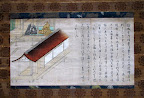 One final point, bridging language and culture: as I mentioned in the post about Japanese culture, the ability to write beautifully is considered an important skill, and many of the Japanese cultural treasures consist simply of handwritten text. Moreover, rulers were expected to possess this skill, and there are many examples of poetry hand-written by emperors of the past, letters written by the emperors’ wives, and so on. A poem should look beautiful on the page, in addition to being beautiful to hear.
The Japan album in my photos includes a number of examples from the Tokyo National Museum, including the one above left, which I like a lot, and which mixes pictorial art with calligraphy.


 So, then, how about when the news media report that on Christmas day, Umar Farouk Abdulmutallab “almost brought down a Northwest Airlines jetliner”? I’ve seen that and many similar statements in newspapers and on television news, over the last few days. But how close is “almost”? How far from actuality can we get before “almost” is inappropriate? And do we want the news media engaging in hyperbole?


 The traffic agents (New York City uses a civilian force to write parking tickets) may be overzealous, indeed, but a “grace period” will change nothing in that regard. If you think you have 45 minutes on the meter, and come back in 47 minutes to see an agent placing a ticket under your wiper... will it really be any different if you think you have 50 minutes and come back in 52 to the same scene?
 As we approach the shortest daylight-period of the year, we, many of us, prepare to celebrate Midwinter, Yule, Winter Solstice, or... Christmas, a week from today — yes, even some of us who do not celebrate Christ do follow the secular festivities. We’ll enjoy indoor trees, lights and doo-dads, cookies, cakes, and “stocking stuffers”. We’ll listen to seasonal music (whether we